

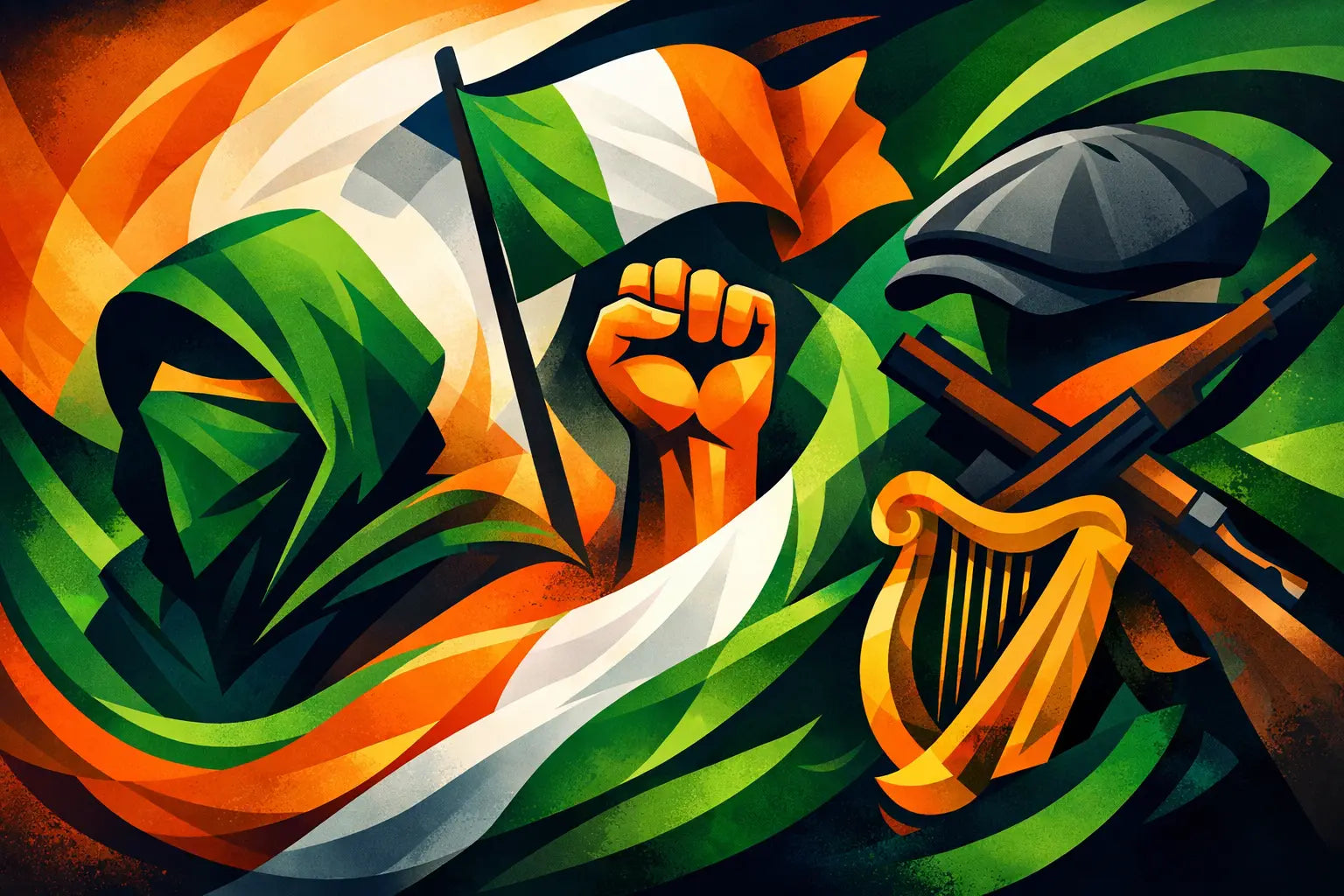
A shamrock slapped on a cheap tee is not rebellion. A tricolour printed without thought is not identity either. Irish rebellion clothing only means something when it carries weight - history, attitude, memory, and a clear sense of who it is for.
That is the line between costume and culture. One is worn for a night out or a themed weekend. The other becomes part of how you show up every day. If you care about Irish heritage, and you want your clothes to say more than "I’ve been to Dublin once", then the details matter.
What Irish rebellion clothing really stands for
At its best, Irish rebellion clothing is not about dressing up as the past. It is about carrying a tradition of resistance into the present. That can mean national pride. It can mean cultural survival. It can mean language, land, memory, working-class edge, anti-establishment attitude, or simply refusing to flatten Irish identity into something tidy and sellable.
Rebellion in an Irish context has never been just one thing. For some, it points directly to the Easter Rising, the War of Independence, hunger strikes, protest songs, murals, and political symbolism. For others, it is broader and more personal - speaking Irish when the world expects English, wearing a Claddagh ring without apology, or choosing design rooted in heritage over trend-led fashion with no backbone.
That is why the best pieces do not need to shout. Sometimes a Gaelic phrase across the chest says enough. Sometimes an old symbol reworked in a clean modern fit does more than a loud graphic ever could. Meaning carries further when the design has restraint.
The difference between heritage streetwear and costume
This is where plenty of brands get it wrong. They confuse heritage with nostalgia and rebellion with theatrics. The result is clothing that feels more like fancy dress than something you would actually wear on the street.
Good Irish rebellion clothing understands modern style. The cut matters. The fabric matters. The graphic placement matters. If a piece only works in a pub on St Patrick’s Day, it has already failed. Real identity-led clothing should work on an ordinary Tuesday with cargos, denim, a bomber, or a well-worn pair of trainers.
That tension matters. You want history, but you also want wearability. You want symbolism, but not clutter. You want cultural charge, but not something that looks trapped in 2006 souvenir-shop design.
The strongest brands in this space treat Irishness as a design language, not a gimmick. They draw from old slogans, county pride, rebel iconography, sport, religion, resistance, and diaspora memory, then edit hard. What survives the edit is what people actually wear.
Why less often hits harder
There is a reason clean statement pieces last longer in the wardrobe. They leave room for the person wearing them. A shirt with a single sharp phrase in Irish can feel stronger than one crowded with harps, flags, wolves and Celtic knots all fighting for space.
Minimal does not mean empty. It means confident enough not to over-explain. That matters for anyone who wants clothing to feel personal rather than performative.
The symbols behind irish rebellion clothing
Not every symbol carries the same charge, and not every wearer wants the same thing from it. That is worth saying plainly. Some people want direct political references. Others want cultural connection without wearing something openly confrontational. It depends on your own relationship to Irish identity.
The harp, for example, can signal nationhood, culture, sovereignty and continuity. The Claddagh leans more intimate - love, loyalty, belonging - but in the right context it still speaks to heritage with force. Gaelic script can feel proud, grounded and unmistakably Irish, especially when used with purpose rather than decoration. County references, old battle cries, rebel songs, saints, sporting motifs and historic dates all land differently depending on how they are designed.
That is the trade-off. The more specific the symbol, the stronger and narrower its message. The more universal the symbol, the easier it is to wear across contexts, but sometimes with less edge. Neither route is wrong. It comes down to whether you want the piece to start a conversation, hold personal meaning quietly, or do both.
Wearing symbolism without reducing it
There is a fine line between honouring history and flattening it into aesthetics. The safest way to avoid that is simple - know what you are wearing. If a phrase comes from a political movement, understand the movement. If a date marks an uprising or a death, treat it with respect. If a symbol has regional or sectarian weight, be honest about that too.
Style can carry meaning. It should not erase it.
How to wear Irish rebellion clothing now
The easiest mistake is overbuilding the outfit. If the piece already carries a message, let it lead. A strong graphic tee or Gaelic slogan sweatshirt does not need five more symbols piled on top.
Pairing heritage-led clothing with modern basics usually gives the best result. Clean trousers, dark denim, a structured jacket, a simple cap - these keep the look current and stop it tipping into costume. Jewellery works the same way. One ring, chain or pendant with clear symbolism often lands better than stacking every Irish reference you own at once.
Fit is part of the message too. Oversized can work if the design has a streetwear edge. Boxy tees, heavier cotton and cropped outerwear can make historical references feel modern without stripping them of substance. On the other hand, if the garment leans more classic - say a knit, flat cap or rugby-style jersey - then sharper styling can keep it from feeling dated.
This is also where diaspora style has its own lane. If you grew up outside Ireland, clothing can become a way to claim connection without turning that connection into performance. The best approach is usually the most honest one. Wear what feels lived in, not borrowed. You do not need to prove your Irishness by putting every symbol on your body at once.
Why the diaspora connects so strongly to it
For people in Britain, the US, Australia and beyond, Irish identity can feel both close and far away. It lives in names, family stories, songs, old photographs, accents half-kept and half-lost. Clothing makes that connection visible.
That matters more than outsiders sometimes realise. A well-made piece of Irish rebellion clothing can do what generic heritage merch never does - it lets someone carry culture into ordinary life. Not on a special occasion. Not once a year. Every day.
There is power in that. Especially for second- or third-generation Irish people who have inherited pride but not always fluency, certainty or direct access. Wearing something rooted in Irish language, symbolism or resistance can become a way of saying, this is still mine.
It is not about permission. It is about recognition.
What to look for before you buy
If a piece claims rebellion, ask what exactly it is rebelling against. If it claims heritage, ask whether the design feels considered or copied. Quality and intent tend to show up fast.
Look at the cut first. If it feels cheap, dated or badly printed, the message will not survive the wear. Then look at the symbolism. Is it there because it means something, or because someone thought Irish equals green plus random Celtic pattern? Strong design has clarity. It knows when to push and when to pull back.
You should also think about how often you will wear it. A piece with depth does not have to be loud. In fact, the best ones often become staples because they balance statement with restraint. They fit your life, not just your mood.
That is where brands like EIRIN have shifted the conversation. Irish clothing does not need to look like souvenir stock or heritage theatre. It can be sharp, current and still carry the old fire.
Irish rebellion clothing is not for blending in
The point is not to dress safely. It is not to smooth away history until it becomes decorative. It is to wear something with roots and let those roots show.
Some people will always prefer neutral fashion with no friction in it. Fine. But if your clothes are part of how you speak, then Irish rebellion clothing offers a language worth using - one built on memory, pride, refusal and style that does not ask for approval.
Wear the piece that says where you stand. Wear the symbol you understand. Wear your heritage like it belongs in the present, because it does.


![Eirin Apparel Claddagh Earrings Chunky Gold-Plated Claddagh Hoop Earrings – 'Soláis' (Sunlight) [collection-cover-only]](http://eirin.co/cdn/shop/files/eirin-apparel-claddagh-earrings-chunky-gold-plated-claddagh-hoop-earrings-solais-sunlight-1260024173.png?v=1790378984&width=1254)

![Eirin Apparel Claddagh Earrings Chunky Silver-Plated Claddagh Hoop Earrings – 'Réalta' (Starlight) [collection-cover-only]](http://eirin.co/cdn/shop/files/eirin-apparel-claddagh-earrings-chunky-silver-plated-claddagh-hoop-earrings-realta-starlight-1260024174.png?v=1790378955&width=1254)

![Eirin Apparel Claddagh Earrings Dainty Gold-Plated Claddagh Hoop Earrings – 'Gríanóg' (Little Sun) [collection-cover-only]](http://eirin.co/cdn/shop/files/eirin-apparel-claddagh-earrings-dainty-gold-plated-claddagh-hoop-earrings-grianog-little-sun-1260024172.png?v=1790379015&width=2048)

![Eirin Apparel Claddagh Earrings Gold-Plated Sterling Silver Claddagh Earrings – ‘Croi Óir’ (Golden Heart) [collection-cover-only]](http://eirin.co/cdn/shop/files/eirin-apparel-claddagh-earrings-gold-plated-sterling-silver-claddagh-earrings-croi-oir-golden-heart-1260024175.png?v=1790378802&width=2048)

![Eirin Apparel Claddagh Earrings Celtic Knot Claddagh Earrings – ‘Fáinne an Ghrá’ (Ring of Love) [collection-cover-only]](http://eirin.co/cdn/shop/files/eirin-apparel-claddagh-earrings-celtic-knot-claddagh-earrings-fainne-an-ghra-ring-of-love-1260024176.png?v=1790378776&width=2048)

![Eirin Apparel Women's Earrings Women's Irish Harp Earrings – 'Fuaim' (Sound) [collection-cover-only]](http://eirin.co/cdn/shop/files/eirin-apparel-women-s-earrings-women-s-irish-harp-earrings-fuaim-sound-1260024177.png?v=1790378295&width=2048)


![Eirin Apparel Claddagh Ring Women's Gold-Plated Classic Claddagh Ring – ‘Gréine’ (Of the Sun) [collection-cover-only]](http://eirin.co/cdn/shop/files/eirin-apparel-claddagh-ring-women-s-gold-plated-classic-claddagh-ring-greine-of-the-sun-1260024155.png?v=1790378897&width=1254)

![Eirin Apparel Claddagh Ring Women's Silver-Plated Classic Claddagh Ring – ‘Gealaí’ (Moonlight) [collection-cover-only]](http://eirin.co/cdn/shop/files/eirin-apparel-claddagh-ring-women-s-silver-plated-classic-claddagh-ring-gealai-moonlight-1260024154.png?v=1790378925&width=2048)

![Eirin Apparel Claddagh Ring Women’s Two-Tone Claddagh Ring – ‘Síorghrá’ (Eternal Love) [collection-cover-only]](http://eirin.co/cdn/shop/files/eirin-apparel-claddagh-ring-women-s-two-tone-claddagh-ring-siorghra-eternal-love-1260024158.png?v=1790378653&width=1254)

![Eirin Apparel Claddagh Ring Women’s Chunky Claddagh Ring – 'Dílse' (Faithful) [collection-cover-only]](http://eirin.co/cdn/shop/files/eirin-apparel-claddagh-ring-women-s-chunky-claddagh-ring-dilse-faithful-1260024159.png?v=1790378561&width=1254)

![Eirin Apparel Women's Ring Women's Celtic Knot Ring – 'Síorfhite' (Everwoven) [collection-cover-only]](http://eirin.co/cdn/shop/files/eirin-apparel-women-s-ring-women-s-celtic-knot-ring-siorfhite-everwoven-1260024160.png?v=1790378476&width=1254)


