

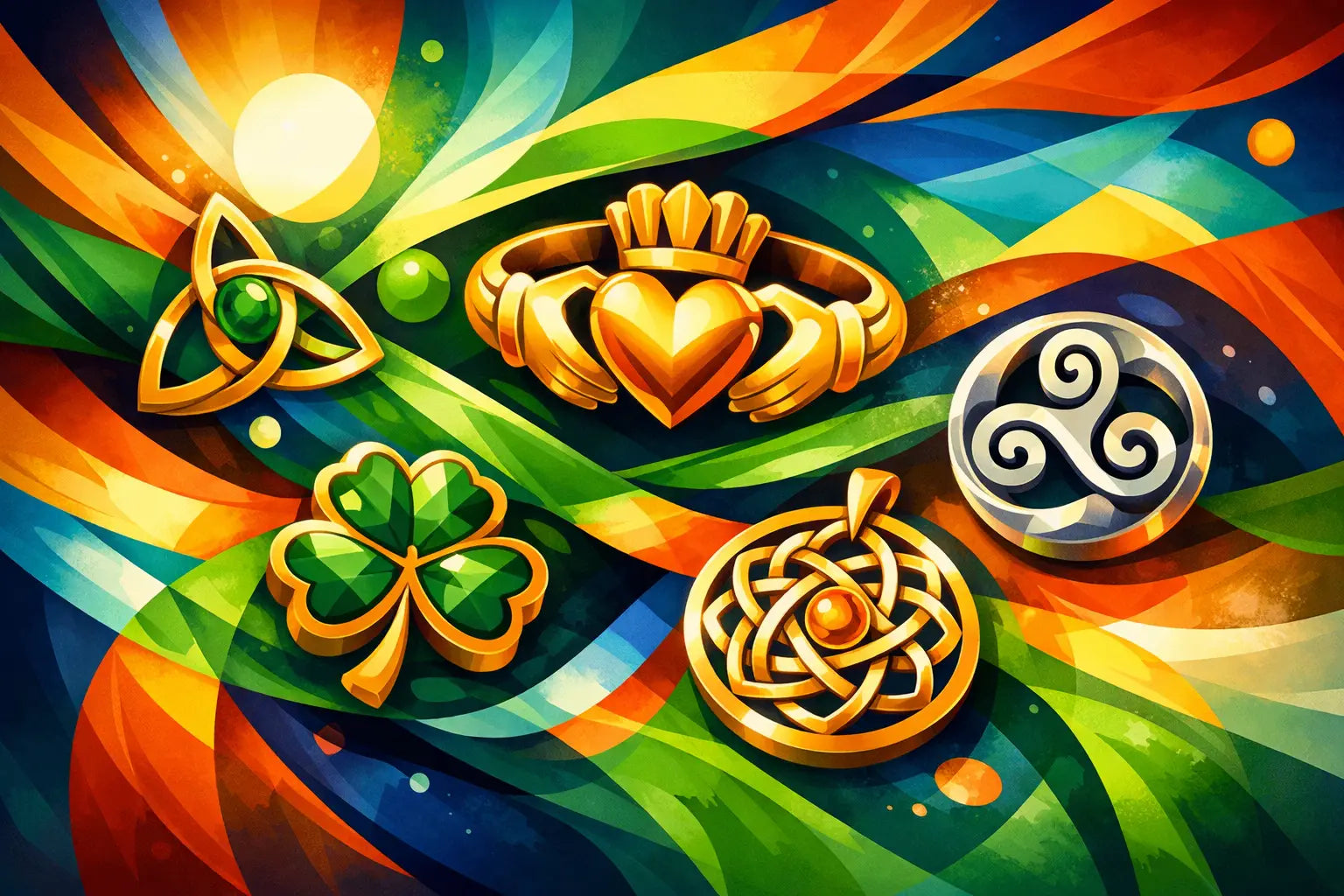
A ring is never just a ring when it carries a language of its own. That is why Irish symbol jewellery still hits differently. It does more than finish an outfit. It says where you stand, what you carry, and which stories you refuse to leave behind.
The best pieces are not costume. They are not souvenir-shop clichés dressed up as heritage. They hold their ground in the real world - worn with a T-shirt, under a cuff, layered with silver, gifted across generations, or chosen quietly for yourself. Irish symbolism has lasted because it means something. The jewellery only works when that meaning stays intact.
Why Irish symbol jewellery still matters
People do not wear symbolic jewellery by accident. They wear it because plain aesthetics are not enough. A symbol gives shape to feeling - loyalty, love, ancestry, protection, grief, defiance, belonging. Irish culture has always understood that. Its symbols were never empty decoration. They were marks of kinship, faith, continuity and resistance.
That matters even more now, when so much fashion feels disposable. If you are part of the diaspora, Irish symbol jewellery can be a daily link to somewhere you know deeply or are still learning to claim. If you are from Ireland, it can be a way of wearing heritage without reducing it to nostalgia. Either way, the appeal is the same. Identity looks better when it is worn with intent.
There is also a practical reason these pieces endure. Symbolic jewellery is versatile. It can be bold without shouting. It can sit inside a modern wardrobe without looking stuck in another era. A clean silver Claddagh ring, a fine triskele pendant, or a knotwork bracelet can feel sharp, current and personal all at once.
The symbols behind Irish symbol jewellery
Not every Irish symbol says the same thing, and that is where the real interest begins. Choosing a piece should be less about buying the most recognisable motif and more about finding the one that matches what you want to carry.
The Claddagh
This is the one most people know, and for good reason. The hands stand for friendship, the heart for love, and the crown for loyalty. It is direct, balanced and emotionally clear. That simplicity is its strength.
A Claddagh ring can mark a relationship, but it does not have to be romantic. It can just as easily represent love of family, loyalty to home, or respect for your roots. That wider meaning is why it has lasted far beyond trend cycles. It belongs to people, not to a single occasion.
The triskele
The triskele carries movement. Three spirals turning from a shared centre suggest cycles, energy and continuity. Interpretations vary - life, death and rebirth; land, sea and sky; past, present and future. That flexibility is part of its power.
Visually, it feels cleaner and more graphic than some traditional motifs, which makes it especially strong in contemporary jewellery. If you want something symbolic that looks sharp with modern styling, the triskele earns its place.
Celtic knotwork
Celtic knots are often misunderstood as simply ornamental, but their unbroken lines matter. They suggest eternity, connection and interdependence. No clear beginning, no clear end. That can speak to family bonds, spiritual belief or the idea that identity is never made in isolation.
The trade-off is that knotwork can slip into overworked design if handled badly. Too much detail can make a piece feel fussy. The strongest versions keep the linework crisp and let the symbol breathe.
The shamrock
The shamrock is easy to dismiss because it has been overused, but that does not strip it of meaning. Historically tied to Ireland and often associated with faith, it still holds symbolic weight when used with restraint.
The key word is restraint. A shamrock rendered in a clean, minimal form can feel confident and modern. A novelty version usually does the opposite. Same symbol, very different result.
The Celtic cross and other faith-led motifs
For some wearers, jewellery is also an expression of belief. The Celtic cross combines spiritual meaning with a deeply rooted visual tradition. Worn simply, it can carry both personal faith and cultural identity.
This is where intention matters. Some people choose these motifs for heritage, others for religion, and many for both. Neither reading is wrong, but the piece should match the weight of what it represents.
Style first, symbolism intact
The difference between powerful jewellery and forgettable jewellery often comes down to design discipline. Heritage does not need to be loud to be visible. In fact, the strongest Irish symbol jewellery usually avoids excess.
A good symbolic piece should work with how people actually dress now. That means cleaner profiles, better proportions and materials that feel considered rather than gimmicky. Silver remains a favourite because it has clarity and edge. Gold can work too, especially when the design is stripped back and the symbol is allowed to lead.
Scale matters more than many people realise. A large pendant can feel right if the rest of the look is simple. A smaller ring or chain may be the better choice if you want something you never take off. There is no single correct approach. It depends on whether you want the jewellery to start the conversation or sit closer to the body, known mainly by you.
That is also why modern Irish design has moved away from the old tourist-shop formula. People want pieces they can wear with a bomber jacket, a knit, a football jersey or a white shirt - not objects that only make sense on St Patrick's Day. Heritage deserves better than seasonal dress-up.
How to choose Irish symbol jewellery without getting it wrong
Start with meaning, not trend. Ask yourself what you actually want the piece to say. Love and loyalty? Continuity? Protection? A connection to Irishness that feels personal rather than performative? Once you know that, the symbol becomes easier to choose.
Then look at wearability. A piece can be rich in meaning and still be wrong for your life. If you use your hands constantly, a high-profile ring may annoy you. If you like to layer chains, a compact pendant may work better than something oversized. Good jewellery should fit your style, not force a costume change.
Material matters too. If you want something for daily wear, durability counts. Finishing counts as well. A symbol with fine linework needs sharp execution or it loses impact. Cheap plating, muddy engraving and bulky forms can flatten even the most meaningful design.
It is also worth being honest about authenticity. Irish-inspired and Irish-rooted are not always the same thing. Some pieces borrow the surface look of Celtic design without respecting the symbol behind it. If the meaning matters to you, choose jewellery that treats the motif with clarity rather than using it as generic decoration.
Wearing identity without overexplaining it
The appeal of symbolic jewellery is that it speaks before you do. You do not need to narrate your heritage every time you get dressed. Sometimes a ring, chain or bracelet does enough.
That is especially true for people whose connection to Ireland is layered. Maybe you grew up there. Maybe your grandparents did. Maybe you are still piecing together what that inheritance means. Jewellery cannot answer every question of identity, but it can make that connection tangible. Not loud. Not forced. Just present.
There is strength in that kind of expression. It refuses the idea that heritage must be hidden, diluted or turned into a joke to be wearable. It can be part of a modern wardrobe and still hold real weight. That is where brands like EIRIN have shifted the conversation - away from souvenir culture and towards pieces that feel lived in, current and unapologetically rooted.
When symbolism becomes personal
The most lasting jewellery usually arrives at a moment that matters. A gift from a parent. A ring bought after moving away from home. A pendant chosen after reconnecting with family history. A bracelet worn as a private reminder of loyalty, grief or love. The symbol may be ancient, but the meaning becomes yours.
That is why people keep these pieces for years. They age with the wearer. Scratches become part of the story. The shine softens. The emotional charge deepens. Good symbolic jewellery is not static. It gathers life.
If you are choosing a piece now, do not worry about finding the most impressive symbol. Find the one you will still want to wear when the novelty has gone. Find the one that still feels true on an ordinary Tuesday. That is usually the right one.
Wear the symbol that holds its nerve. The one that says something real, even in silence.


![Eirin Apparel Claddagh Earrings Chunky Gold-Plated Claddagh Hoop Earrings – 'Soláis' (Sunlight) [collection-cover-only]](http://eirin.co/cdn/shop/files/eirin-apparel-claddagh-earrings-chunky-gold-plated-claddagh-hoop-earrings-solais-sunlight-1260024173.png?v=1790378984&width=1254)

![Eirin Apparel Claddagh Earrings Chunky Silver-Plated Claddagh Hoop Earrings – 'Réalta' (Starlight) [collection-cover-only]](http://eirin.co/cdn/shop/files/eirin-apparel-claddagh-earrings-chunky-silver-plated-claddagh-hoop-earrings-realta-starlight-1260024174.png?v=1790378955&width=1254)

![Eirin Apparel Claddagh Earrings Dainty Gold-Plated Claddagh Hoop Earrings – 'Gríanóg' (Little Sun) [collection-cover-only]](http://eirin.co/cdn/shop/files/eirin-apparel-claddagh-earrings-dainty-gold-plated-claddagh-hoop-earrings-grianog-little-sun-1260024172.png?v=1790379015&width=2048)

![Eirin Apparel Claddagh Earrings Gold-Plated Sterling Silver Claddagh Earrings – ‘Croi Óir’ (Golden Heart) [collection-cover-only]](http://eirin.co/cdn/shop/files/eirin-apparel-claddagh-earrings-gold-plated-sterling-silver-claddagh-earrings-croi-oir-golden-heart-1260024175.png?v=1790378802&width=2048)

![Eirin Apparel Claddagh Earrings Celtic Knot Claddagh Earrings – ‘Fáinne an Ghrá’ (Ring of Love) [collection-cover-only]](http://eirin.co/cdn/shop/files/eirin-apparel-claddagh-earrings-celtic-knot-claddagh-earrings-fainne-an-ghra-ring-of-love-1260024176.png?v=1790378776&width=2048)

![Eirin Apparel Women's Earrings Women's Irish Harp Earrings – 'Fuaim' (Sound) [collection-cover-only]](http://eirin.co/cdn/shop/files/eirin-apparel-women-s-earrings-women-s-irish-harp-earrings-fuaim-sound-1260024177.png?v=1790378295&width=2048)


![Eirin Apparel Claddagh Ring Women's Gold-Plated Classic Claddagh Ring – ‘Gréine’ (Of the Sun) [collection-cover-only]](http://eirin.co/cdn/shop/files/eirin-apparel-claddagh-ring-women-s-gold-plated-classic-claddagh-ring-greine-of-the-sun-1260024155.png?v=1790378897&width=1254)

![Eirin Apparel Claddagh Ring Women's Silver-Plated Classic Claddagh Ring – ‘Gealaí’ (Moonlight) [collection-cover-only]](http://eirin.co/cdn/shop/files/eirin-apparel-claddagh-ring-women-s-silver-plated-classic-claddagh-ring-gealai-moonlight-1260024154.png?v=1790378925&width=2048)

![Eirin Apparel Claddagh Ring Women’s Two-Tone Claddagh Ring – ‘Síorghrá’ (Eternal Love) [collection-cover-only]](http://eirin.co/cdn/shop/files/eirin-apparel-claddagh-ring-women-s-two-tone-claddagh-ring-siorghra-eternal-love-1260024158.png?v=1790378653&width=1254)

![Eirin Apparel Claddagh Ring Women’s Chunky Claddagh Ring – 'Dílse' (Faithful) [collection-cover-only]](http://eirin.co/cdn/shop/files/eirin-apparel-claddagh-ring-women-s-chunky-claddagh-ring-dilse-faithful-1260024159.png?v=1790378561&width=1254)

![Eirin Apparel Women's Ring Women's Celtic Knot Ring – 'Síorfhite' (Everwoven) [collection-cover-only]](http://eirin.co/cdn/shop/files/eirin-apparel-women-s-ring-women-s-celtic-knot-ring-siorfhite-everwoven-1260024160.png?v=1790378476&width=1254)


