

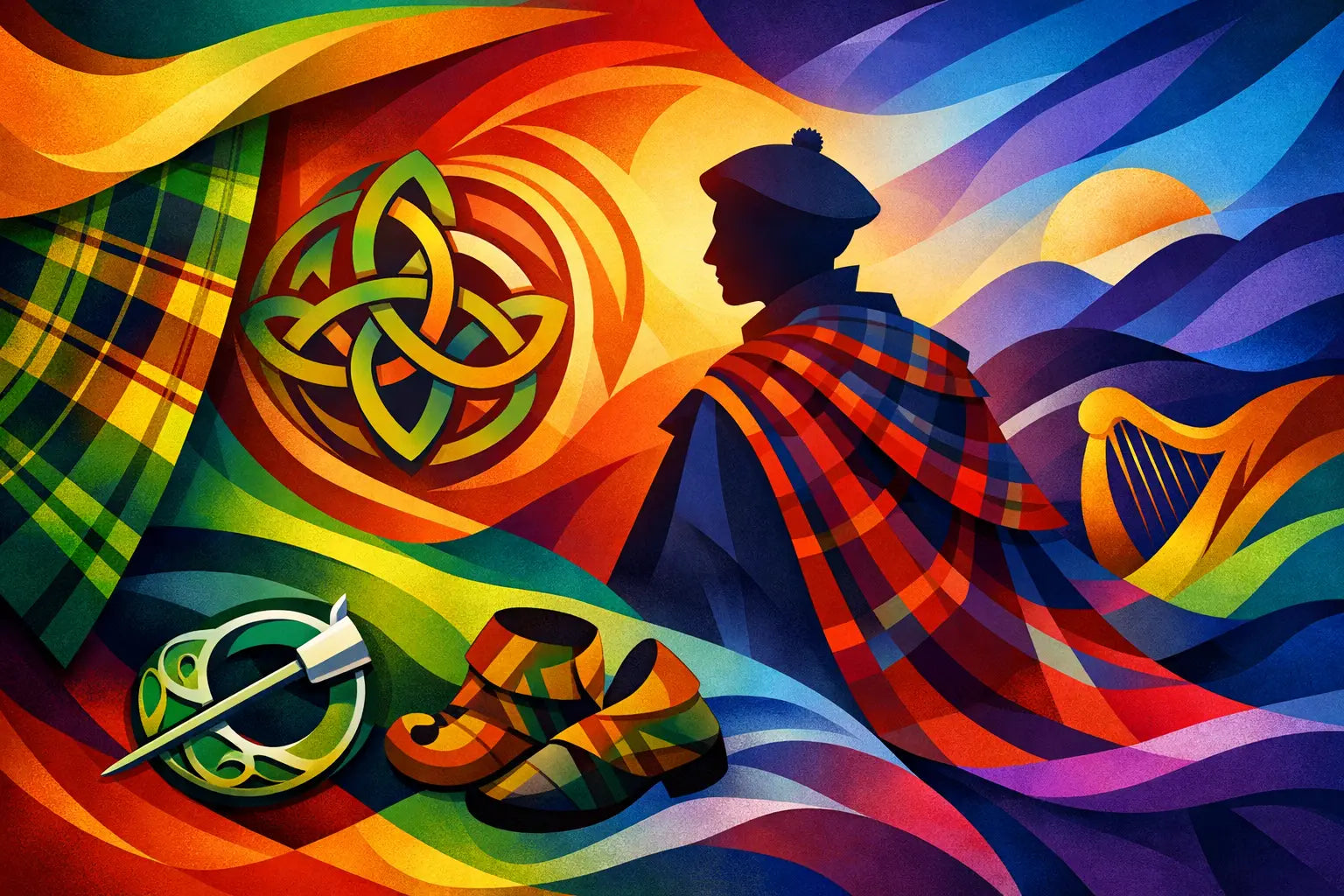
A Gaeilge tee in Manchester. A Claddagh ring in Toronto. A flat cap worn nowhere near a pub or parade. Can anyone wear Gaelic clothing? Yes. Culture is not a gated community, and Irish identity has travelled far beyond the island. But wearing it well means knowing the difference between connection and costume.
Gaelic clothing is not one fixed uniform. It can mean contemporary Irish-designed streetwear, clothing carrying the Irish language, GAA-inspired pieces, tartan, Celtic symbols, traditional garments or jewellery with a long history. Each comes with its own context. The best rule is simple: wear it because it means something, or because you have taken the time to understand what it says.
Can Anyone Wear Gaelic Clothing? Start With Respect
Irish culture has always crossed borders. Migration, music, sport, family and friendship have built Irish communities everywhere. You do not need an Irish passport, surname or family tree to appreciate Gaelic design. You can wear a Gaelic slogan, a shamrock, a Claddagh or a heritage-inspired jersey if it speaks to you.
What matters is the attitude behind it. Wear it as a living culture, not a novelty. That means avoiding the lazy version of Irishness: plastic leprechauns, fake accents, green-for-the-sake-of-green and anything that turns a people into a punchline.
There is a difference between wearing a well-made Irish-language top because you like the message and putting on a caricature for a themed night out. One shows interest and intent. The other borrows the surface while missing the substance.
Respect does not mean walking on eggshells. It means being curious enough to ask what a word, symbol or colour represents before putting it on your chest.
Gaelic Is Not Just a Look
The word “Gaelic” is often used broadly, but language matters. In Ireland, the language is generally called Irish or Gaeilge. “Gaelic” may be understood, especially outside Ireland, but it can also refer to the wider family of Goidelic languages, including Scottish Gaelic and Manx.
That distinction is worth carrying with you. Irish and Scottish traditions share deep roots, but they are not interchangeable. A kilt, for example, is strongly associated with Scotland, while an Aran jumper has a particular place in Irish clothing history. Celtic design may overlap across these nations, yet a vague “Celtic” label can flatten cultures that deserve to be seen clearly.
The same goes for language clothing. If you wear Gaeilge, know what it says. A phrase can be proud, funny, romantic or political. Its meaning is part of the design. Treating it as decorative squiggles is a missed opportunity at best and disrespectful at worst.
A quick check before buying or wearing a phrase is enough: is the spelling right, is the translation accurate, and does the wording fit the context? Irish has regional variation and a living everyday presence. It is not an ancient prop.
Symbols Carry Stories
Irish symbols are widely worn because they are powerful, clean and instantly recognisable. That does not make them empty. A little knowledge lets you wear them with more confidence.
The Claddagh, with its hands, heart and crown, stands for friendship, love and loyalty. It is often given as a meaningful gift, and traditions around which hand or direction it faces are still observed by some wearers. You do not have to follow every convention, but knowing there is one shows the piece is more than jewellery.
The shamrock has associations with Ireland and, in Christian tradition, the Holy Trinity. The harp is a national symbol with a long political and cultural history. The tricolour represents ideas of peace between traditions on the island, even though its use can feel political depending on the setting. Celtic knots are beautiful, but their modern use is far broader than any one original meaning.
None of this means symbols should be locked away. It means you should not claim meanings you have not checked or turn sensitive imagery into a party accessory. If a design includes flags, political slogans or references to conflict, understand that it may land differently in Belfast, Dublin, Glasgow or Boston. Context changes the read.
Wear Heritage as Everyday Style, Not Fancy Dress
The strongest Gaelic clothing does not need to shout “tourist”. It should work in your actual wardrobe. A heavyweight tee with a sharp Gaeilge line, a retro jersey, a clean cap or a piece of symbolic jewellery can carry heritage without looking like a souvenir rack.
Keep the styling honest. Pair a Gaelic top with denim, cargos or tailored trousers. Let a Claddagh ring or harp pendant do its job without piling every Irish symbol into one outfit. A heritage piece has more impact when it is chosen, not thrown on.
This is also where quality matters. Poorly printed novelty wear often relies on clichés because it has nothing else to offer. Better pieces use language, colour, type and symbolism with purpose. They look contemporary because they are made for people living now, not for an imagined version of the past.
For diaspora communities, this can be especially personal. You may have grown up with fragments: a grandparent’s stories, a family name, songs at home, a county connection or a yearly visit. Clothing can be a visible way to bring that connection into daily life. You do not need to prove your identity to strangers to wear it.
At the same time, no one should use a distant link to speak over people who live the culture every day. Belonging can be real without becoming ownership.
When to Pause Before You Wear It
Most Irish-inspired clothing is straightforward. But some pieces ask for a little more thought. Political insignia, paramilitary references, sectarian slogans, conflict-era imagery and altered flags can carry pain that is still close to the surface. They are not neutral graphics.
If you do not understand a reference, do not bluff it. Ask, research it, or choose something else. Being told that a symbol is controversial is not a challenge to be more provocative. Sometimes the boldest move is knowing what you are representing.
Sport deserves context too. GAA shirts and county colours are worn proudly around the world, and plenty of people wear them in support of friends, clubs or places they love. Just do not pretend allegiance you do not have, particularly in local settings where rivalries run deep. Be clear, be respectful and enjoy the sport for what it is.
A Better Question Than Permission
Instead of asking whether you are “allowed” to wear Gaelic clothing, ask what relationship you want with it. Are you celebrating family? Learning the language? Supporting Irish makers? Drawn to a message of resistance, belonging or pride? Or are you reaching for a shortcut stereotype?
That question changes the whole outfit. It moves clothing from consumption to expression.
Irish culture has room for people who show up with genuine interest. Wear the language correctly. Choose symbols with care. Support design that treats heritage as something alive, not something trapped in a gift shop.
Wear what carries meaning. Wear it with your own style. And if someone asks what it says, be ready to tell them.


![Eirin Apparel Claddagh Earrings Chunky Gold-Plated Claddagh Hoop Earrings – 'Soláis' (Sunlight) [collection-cover-only]](http://eirin.co/cdn/shop/files/eirin-apparel-claddagh-earrings-chunky-gold-plated-claddagh-hoop-earrings-solais-sunlight-1260024173.png?v=1790378984&width=1254)

![Eirin Apparel Claddagh Earrings Chunky Silver-Plated Claddagh Hoop Earrings – 'Réalta' (Starlight) [collection-cover-only]](http://eirin.co/cdn/shop/files/eirin-apparel-claddagh-earrings-chunky-silver-plated-claddagh-hoop-earrings-realta-starlight-1260024174.png?v=1790378955&width=1254)

![Eirin Apparel Claddagh Earrings Dainty Gold-Plated Claddagh Hoop Earrings – 'Gríanóg' (Little Sun) [collection-cover-only]](http://eirin.co/cdn/shop/files/eirin-apparel-claddagh-earrings-dainty-gold-plated-claddagh-hoop-earrings-grianog-little-sun-1260024172.png?v=1790379015&width=2048)

![Eirin Apparel Claddagh Earrings Gold-Plated Sterling Silver Claddagh Earrings – ‘Croi Óir’ (Golden Heart) [collection-cover-only]](http://eirin.co/cdn/shop/files/eirin-apparel-claddagh-earrings-gold-plated-sterling-silver-claddagh-earrings-croi-oir-golden-heart-1260024175.png?v=1790378802&width=2048)

![Eirin Apparel Claddagh Earrings Celtic Knot Claddagh Earrings – ‘Fáinne an Ghrá’ (Ring of Love) [collection-cover-only]](http://eirin.co/cdn/shop/files/eirin-apparel-claddagh-earrings-celtic-knot-claddagh-earrings-fainne-an-ghra-ring-of-love-1260024176.png?v=1790378776&width=2048)

![Eirin Apparel Women's Earrings Women's Irish Harp Earrings – 'Fuaim' (Sound) [collection-cover-only]](http://eirin.co/cdn/shop/files/eirin-apparel-women-s-earrings-women-s-irish-harp-earrings-fuaim-sound-1260024177.png?v=1790378295&width=2048)


![Eirin Apparel Claddagh Ring Women's Gold-Plated Classic Claddagh Ring – ‘Gréine’ (Of the Sun) [collection-cover-only]](http://eirin.co/cdn/shop/files/eirin-apparel-claddagh-ring-women-s-gold-plated-classic-claddagh-ring-greine-of-the-sun-1260024155.png?v=1790378897&width=1254)

![Eirin Apparel Claddagh Ring Women's Silver-Plated Classic Claddagh Ring – ‘Gealaí’ (Moonlight) [collection-cover-only]](http://eirin.co/cdn/shop/files/eirin-apparel-claddagh-ring-women-s-silver-plated-classic-claddagh-ring-gealai-moonlight-1260024154.png?v=1790378925&width=2048)

![Eirin Apparel Claddagh Ring Women’s Two-Tone Claddagh Ring – ‘Síorghrá’ (Eternal Love) [collection-cover-only]](http://eirin.co/cdn/shop/files/eirin-apparel-claddagh-ring-women-s-two-tone-claddagh-ring-siorghra-eternal-love-1260024158.png?v=1790378653&width=1254)

![Eirin Apparel Claddagh Ring Women’s Chunky Claddagh Ring – 'Dílse' (Faithful) [collection-cover-only]](http://eirin.co/cdn/shop/files/eirin-apparel-claddagh-ring-women-s-chunky-claddagh-ring-dilse-faithful-1260024159.png?v=1790378561&width=1254)

![Eirin Apparel Women's Ring Women's Celtic Knot Ring – 'Síorfhite' (Everwoven) [collection-cover-only]](http://eirin.co/cdn/shop/files/eirin-apparel-women-s-ring-women-s-celtic-knot-ring-siorfhite-everwoven-1260024160.png?v=1790378476&width=1254)


