

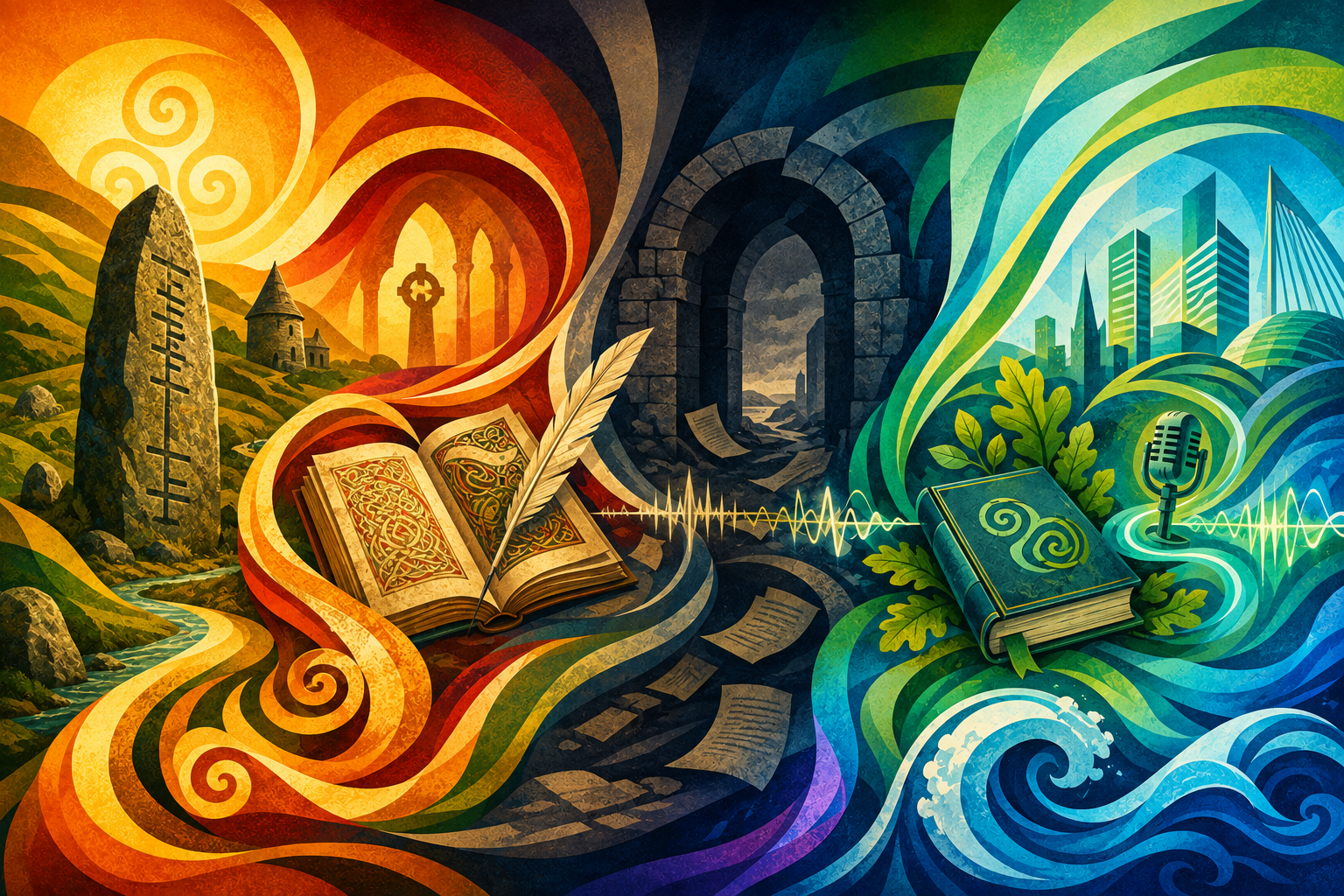
The history of the Irish language—known as Gaeilge—is one of the most compelling linguistic journeys in Europe. As one of the oldest written languages in the world, Irish has survived conquest, cultural suppression, and near extinction, only to re-emerge as a powerful symbol of identity, heritage, and national pride.
In this comprehensive guide, we explore the origins of the Irish language, its evolution through centuries, the forces behind its decline, and the modern efforts driving its revival today.

Origins of the Irish Language: A Celtic Foundation
The Irish language belongs to the Goidelic branch of the Celtic language family, closely related to Scottish Gaelic and Manx Gaelic, while sharing deeper roots with Welsh, Breton, and Cornish.
Arrival of Celtic Speakers in Ireland
It is widely believed that Celtic-speaking peoples arrived in Ireland over 2,500 years ago, bringing with them the early forms of what would become Irish. By the beginning of the Christian era, Irish had become the dominant language across the island, replacing earlier, undocumented tongues.
Irish did not remain confined to Ireland. It spread across:
- Scotland, where it evolved into Scottish Gaelic
- The Isle of Man, where it developed into Manx
- Parts of western Britain
The Romans referred to these Gaelic-speaking peoples as the Scotti, a term that would later give Scotland its name.

Ogham Script: The First Written Irish
The earliest surviving evidence of written Irish appears in the form of Ogham inscriptions, dating from the 5th and 6th centuries.
What is Ogham?
Ogham is an ancient writing system consisting of lines and notches carved along the edges of stones. These inscriptions were primarily used for:
- Marking territory
- Recording names of individuals
- Commemorating lineage
Although relatively simple, Ogham represents a crucial milestone—it marks the transition of Irish from an oral to a written language.

Old Irish (600–900 AD): Europe’s Earliest Vernacular Writing
By the 7th century, Irish began to be written using the Latin alphabet, introduced through Christian monastic culture.
A Linguistic Milestone
Old Irish is widely regarded as:
- The oldest written vernacular language north of the Alps
- A highly sophisticated linguistic system, with complex grammar and inflection
Monastic Influence
Irish monks played a pivotal role in preserving and expanding the language. They produced:
- Religious manuscripts
- Poetry and legal texts
- Early forms of literature and scholarship
This era positioned Ireland as a center of learning in medieval Europe, with Irish scholars traveling across the continent.

Middle Irish (900–1200 AD): Expansion and Literary Flourishing
During the Middle Irish period, the language became more standardized and widely used across Ireland and Gaelic Scotland.
Key Developments
- Simplification of Old Irish grammar
- Growth in storytelling traditions
- Expansion of mythological and heroic literature
Famous works from this era include:
- The Ulster Cycle
- The Fenian Cycle
These texts preserved Ireland’s mythology, legends, and warrior culture, embedding the language deeply within Irish identity.

Early Modern Irish (1200–1600 AD): Stability and Prestige
The Early Modern Irish period marked a time of relative linguistic stability. Irish remained:
- The primary spoken language of the population
- The language of poetry, law, and scholarship
The Bardic Tradition
Professional poets, known as filí, upheld a strict literary tradition:
- Composing highly structured verse
- Preserving genealogies and history
- Serving Gaelic chiefs and nobility
Irish at this time was not just a spoken language—it was a prestigious cultural institution.

Decline of the Irish Language (1600s–1800s)
The decline of the Irish language is one of the most significant chapters in its history.
Colonial Impact and Language Suppression
Following the Tudor conquest and subsequent British rule, English gradually became the language of:
- Government and law
- Education
- Economic opportunity
Irish was increasingly marginalized and associated with poverty and rural life.
The Great Famine (1845–1852)
The Great Famine dealt a devastating blow:
- Massive population loss through death and emigration
- Irish-speaking regions (Gaeltacht areas) were hardest hit
- Survivors often adopted English for survival and mobility
By the late 19th century, Irish had shifted from a majority language to a minority one.

The Gaelic Revival (Late 19th–Early 20th Century)
In response to the language’s decline, a powerful cultural movement emerged—the Gaelic Revival.
Key Organizations and Figures
- Conradh na Gaeilge (The Gaelic League), founded in 1893
- Prominent figures such as Douglas Hyde and Patrick Pearse
Goals of the Revival
- Restore Irish as a spoken language
- Promote Irish in education and public life
- Reconnect people with their cultural heritage
This movement played a crucial role in shaping Irish nationalism and contributed to the eventual push for independence.

Irish Language in Independent Ireland
Following independence in 1922, the Irish government took active steps to revive the language.
Official Status
- Irish was declared the first official language of Ireland
- English remained widely used as a second official language
Education Policies
Irish became:
- A mandatory subject in schools
- A requirement for certain public sector jobs
The Gaeltacht
Designated regions known as the Gaeltacht were established to:
- Preserve native Irish-speaking communities
- Support cultural and linguistic continuity

Modern Irish Language: Use and Relevance Today
Today, the Irish language exists in a complex but evolving landscape.
Where Irish is Spoken
- Daily use in Gaeltacht regions
- Increasing presence in urban communities
- Growing number of Irish-medium schools (Gaelscoileanna)
Media and Technology
Irish has expanded into modern platforms:
- TG4, the Irish-language television channel
- Irish-language radio stations and podcasts
- Digital content, apps, and social media
Cultural Significance
Irish is more than a language—it represents:
- National identity
- Cultural continuity
- A connection to Ireland’s past and future
Is the Irish Language Dying or Reviving?
This question is often debated, but the reality is nuanced.
Challenges
- Limited daily use outside Gaeltacht areas
- Perception of Irish as an academic subject rather than a living language
Signs of Revival
- Growth in young speakers
- Rising popularity of Irish-language education
- Increased visibility in media and branding
Irish is not disappearing—it is transforming.

The Future of the Irish Language
The future of Irish depends on one critical factor: active use.
Key Drivers of Growth
- Community-led initiatives
- Digital innovation and accessibility
- Integration into everyday life
As more people choose to speak, learn, and celebrate Irish, the language continues to evolve beyond preservation—it becomes a living expression of identity.

Conclusion: A Language That Refuses to Fade
The history of the Irish language is not just a timeline—it is a story of resilience, identity, and cultural power.
From ancient Ogham carvings to modern digital platforms, Irish has endured centuries of change. It has survived suppression, adapted to new realities, and continues to inspire new generations.
Today, Irish stands not only as a relic of the past but as a symbol of pride, rebellion, and heritage—a language that refuses to fade.


