

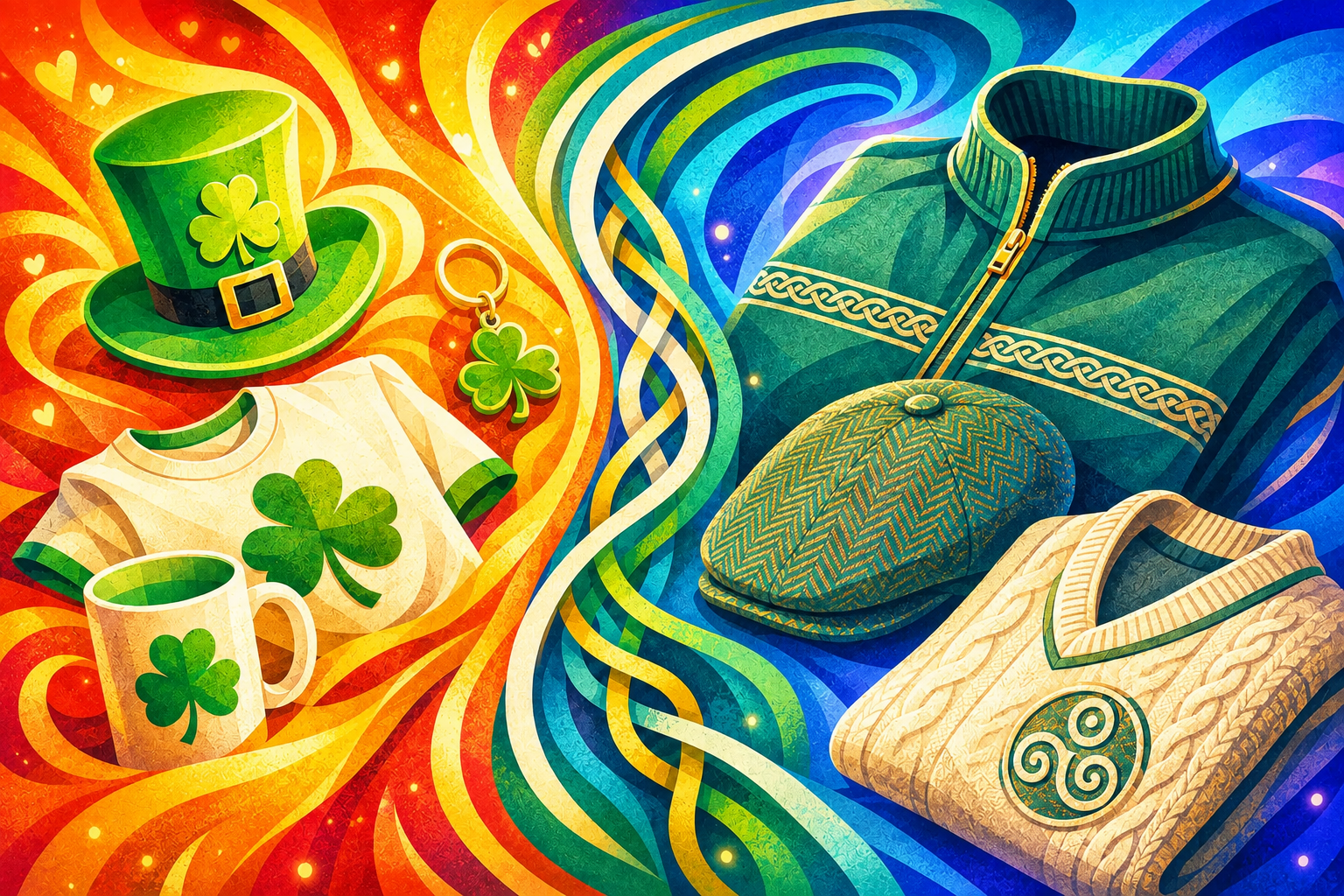
You can spot the difference in seconds. One item gets bought in an airport gift shop, worn once for a laugh, then lost in the back of a drawer. The other becomes part of someone’s uniform. That is the real line in tourist souvenirs vs heritage apparel. One is proof you visited. The other says who you are.
For anyone with a connection to Ireland, that difference matters. Especially now, when identity is not a quiet thing. People are choosing what they wear with more intent. They want pieces that carry meaning without looking like costume, and pride without looking packaged for tourists. Irish culture deserves better than novelty.
What tourist souvenirs vs heritage apparel really means
Tourist souvenirs are usually built for a moment. They are designed to be easy to recognise, easy to buy and easy to gift. Shamrocks splashed across cheap fabric. Slogans played for a wink. Symbols stripped of depth so they can appeal to everyone for five minutes. There is a market for that, and fair enough. Not every purchase has to carry emotional weight.
But heritage apparel plays a different game. It is built to live in a wardrobe, not a suitcase. It takes language, symbolism, history and attitude seriously enough to turn them into something wearable. Not stiff. Not theatrical. Just real. A well-cut tee with Gaeilge that means something. A piece of jewellery that honours the Claddagh without flattening it into cliché. A cap that nods to tradition without pretending the world stopped in 1950.
That distinction is not about price alone, and it is not about being snobbish. A cheap item can still be meaningful, and an expensive one can still be empty. The question is simpler than that: was this made to represent a culture, or just to sell one?
The problem with being reduced to a postcard
Irish identity has been merchandised for generations. Some of it is harmless fun. Some of it turns a living culture into shorthand. When every visual cue gets boiled down to leprechauns, loud green graphics and stage-Irish charm, the result is not pride. It is performance.
That matters because clothes are public. What you wear travels into ordinary life - the school run, the pub, the train, the gym, the shop. If a piece only works on St Patrick’s Day or at an airport terminal, it is not doing much for your everyday sense of self. It is decoration. Heritage apparel should hold up on a Tuesday.
For diaspora communities, the stakes can feel even sharper. A second-generation Irish customer in London, Manchester, Boston or Sydney may not want caricature. They may want something closer to recognition. A garment that says, this is part of me, even if I did not grow up on the same street my grandparents did. That is where design earns its keep.
Why heritage apparel gets worn and souvenirs get stored
The best heritage pieces survive because they make cultural expression usable. They fit into real wardrobes. They work with denim, jackets, trainers and everyday life. They do not ask the wearer to become a mascot.
There is also a confidence difference. Tourist merchandise often shouts because it has very little to say. Heritage apparel can be quieter and stronger at the same time. A symbol placed well. A phrase with weight. A colour palette that nods to history without turning everything into a theme party. When the design is considered, the message lands harder.
That does not mean subtle is always better. Sometimes heritage should be loud. Sometimes a bold Gaelic slogan or a defiant emblem is exactly the point. But loud and lazy are not the same thing. Strong design has intent behind it.
The design test: meaning, quality and attitude
If you want to tell tourist souvenirs from heritage apparel, start with three things: meaning, quality and attitude.
Meaning is the first filter. Is the symbol there because it belongs, or because it is familiar to outsiders? There is a difference between drawing from Irish heritage and pasting Irishness on top of a generic product. Good heritage design knows where its references come from.
Quality is next. Not because heritage has to be luxury, but because poor construction undercuts the message. If the print cracks after a few washes or the fabric feels disposable, the item was probably made for impulse buying, not long-term wear. Identity pieces should last longer than the holiday.
Then there is attitude. Heritage apparel should feel like it stands for something. It does not need a lecture stitched into the hem, but it should carry a point of view. Irishness is not just visual. It is language, resistance, wit, memory, locality, music, sport, politics, family and contradiction. The strongest pieces understand that culture is alive, not archived.
Tourist souvenirs vs heritage apparel in modern Irish style
Modern Irish style has moved far beyond the old binary of either traditional or trend-driven. The best contemporary brands know heritage can sit inside streetwear, sportswear and clean everyday staples without losing its soul. In fact, that is often where it feels most honest.
A retro-inspired jersey can hold memory and edge in the same breath. A Claddagh ring can look sharp rather than sentimental. A flat cap can be reworked so it feels current, not costume. This is where brands such as EIRIN have found their lane - not selling Ireland as a novelty category, but treating it as a living identity with style attached.
That shift matters because it gives people options. You do not have to choose between looking modern and feeling connected. You can wear both. For a younger audience especially, that is the point. Heritage should not ask for permission from fashion. It should show up in it.
When souvenirs still have a place
Not every souvenir deserves contempt. Sometimes a mug from a trip, a silly magnet or a shirt bought in good humour is exactly what it needs to be. Memory has its own value. There is nothing wrong with a keepsake that simply reminds you of where you were.
The issue starts when souvenirs pretend to be heritage, or when heritage gets designed down to the level of a joke. If you want an object to mark a weekend away, buy the object. If you want something to carry your culture into daily life, expect more from it.
There is also room for overlap. A visitor can buy heritage apparel if they connect with the story behind it. And someone from Ireland can enjoy a playful tourist piece without betraying the nation. This is not about purity. It is about intention.
How to buy with more intent
Before you buy, ask a few blunt questions. Would you wear this at home, not just on holiday? Does it feel like clothing, or a prop? Is the symbol being used with respect? Can you imagine reaching for it again in six months?
If the answer is no, it may still be a fun purchase. Just call it what it is. But if the answer is yes, you are probably looking at something with staying power.
The best heritage apparel does not need to beg for attention. It earns a place because it feels personal. It fits your life. It carries the right weight. And it does something rare in fashion - it lets you say something real without overexplaining yourself.
That is the difference worth caring about. Tourist souvenirs capture a moment. Heritage apparel carries one forward. Buy the piece you will still mean when the trip is over.


![Eirin Apparel Claddagh Earrings Chunky Gold-Plated Claddagh Hoop Earrings – 'Soláis' (Sunlight) [collection-cover-only]](http://eirin.co/cdn/shop/files/eirin-apparel-claddagh-earrings-chunky-gold-plated-claddagh-hoop-earrings-solais-sunlight-1260024173.png?v=1790378984&width=1254)

![Eirin Apparel Claddagh Earrings Chunky Silver-Plated Claddagh Hoop Earrings – 'Réalta' (Starlight) [collection-cover-only]](http://eirin.co/cdn/shop/files/eirin-apparel-claddagh-earrings-chunky-silver-plated-claddagh-hoop-earrings-realta-starlight-1260024174.png?v=1790378955&width=1254)

![Eirin Apparel Claddagh Earrings Dainty Gold-Plated Claddagh Hoop Earrings – 'Gríanóg' (Little Sun) [collection-cover-only]](http://eirin.co/cdn/shop/files/eirin-apparel-claddagh-earrings-dainty-gold-plated-claddagh-hoop-earrings-grianog-little-sun-1260024172.png?v=1790379015&width=2048)

![Eirin Apparel Claddagh Earrings Gold-Plated Sterling Silver Claddagh Earrings – ‘Croi Óir’ (Golden Heart) [collection-cover-only]](http://eirin.co/cdn/shop/files/eirin-apparel-claddagh-earrings-gold-plated-sterling-silver-claddagh-earrings-croi-oir-golden-heart-1260024175.png?v=1790378802&width=2048)

![Eirin Apparel Claddagh Earrings Celtic Knot Claddagh Earrings – ‘Fáinne an Ghrá’ (Ring of Love) [collection-cover-only]](http://eirin.co/cdn/shop/files/eirin-apparel-claddagh-earrings-celtic-knot-claddagh-earrings-fainne-an-ghra-ring-of-love-1260024176.png?v=1790378776&width=2048)

![Eirin Apparel Women's Earrings Women's Irish Harp Earrings – 'Fuaim' (Sound) [collection-cover-only]](http://eirin.co/cdn/shop/files/eirin-apparel-women-s-earrings-women-s-irish-harp-earrings-fuaim-sound-1260024177.png?v=1790378295&width=2048)


![Eirin Apparel Claddagh Ring Women's Gold-Plated Classic Claddagh Ring – ‘Gréine’ (Of the Sun) [collection-cover-only]](http://eirin.co/cdn/shop/files/eirin-apparel-claddagh-ring-women-s-gold-plated-classic-claddagh-ring-greine-of-the-sun-1260024155.png?v=1790378897&width=1254)

![Eirin Apparel Claddagh Ring Women's Silver-Plated Classic Claddagh Ring – ‘Gealaí’ (Moonlight) [collection-cover-only]](http://eirin.co/cdn/shop/files/eirin-apparel-claddagh-ring-women-s-silver-plated-classic-claddagh-ring-gealai-moonlight-1260024154.png?v=1790378925&width=2048)

![Eirin Apparel Claddagh Ring Women’s Two-Tone Claddagh Ring – ‘Síorghrá’ (Eternal Love) [collection-cover-only]](http://eirin.co/cdn/shop/files/eirin-apparel-claddagh-ring-women-s-two-tone-claddagh-ring-siorghra-eternal-love-1260024158.png?v=1790378653&width=1254)

![Eirin Apparel Claddagh Ring Women’s Chunky Claddagh Ring – 'Dílse' (Faithful) [collection-cover-only]](http://eirin.co/cdn/shop/files/eirin-apparel-claddagh-ring-women-s-chunky-claddagh-ring-dilse-faithful-1260024159.png?v=1790378561&width=1254)

![Eirin Apparel Women's Ring Women's Celtic Knot Ring – 'Síorfhite' (Everwoven) [collection-cover-only]](http://eirin.co/cdn/shop/files/eirin-apparel-women-s-ring-women-s-celtic-knot-ring-siorfhite-everwoven-1260024160.png?v=1790378476&width=1254)


