

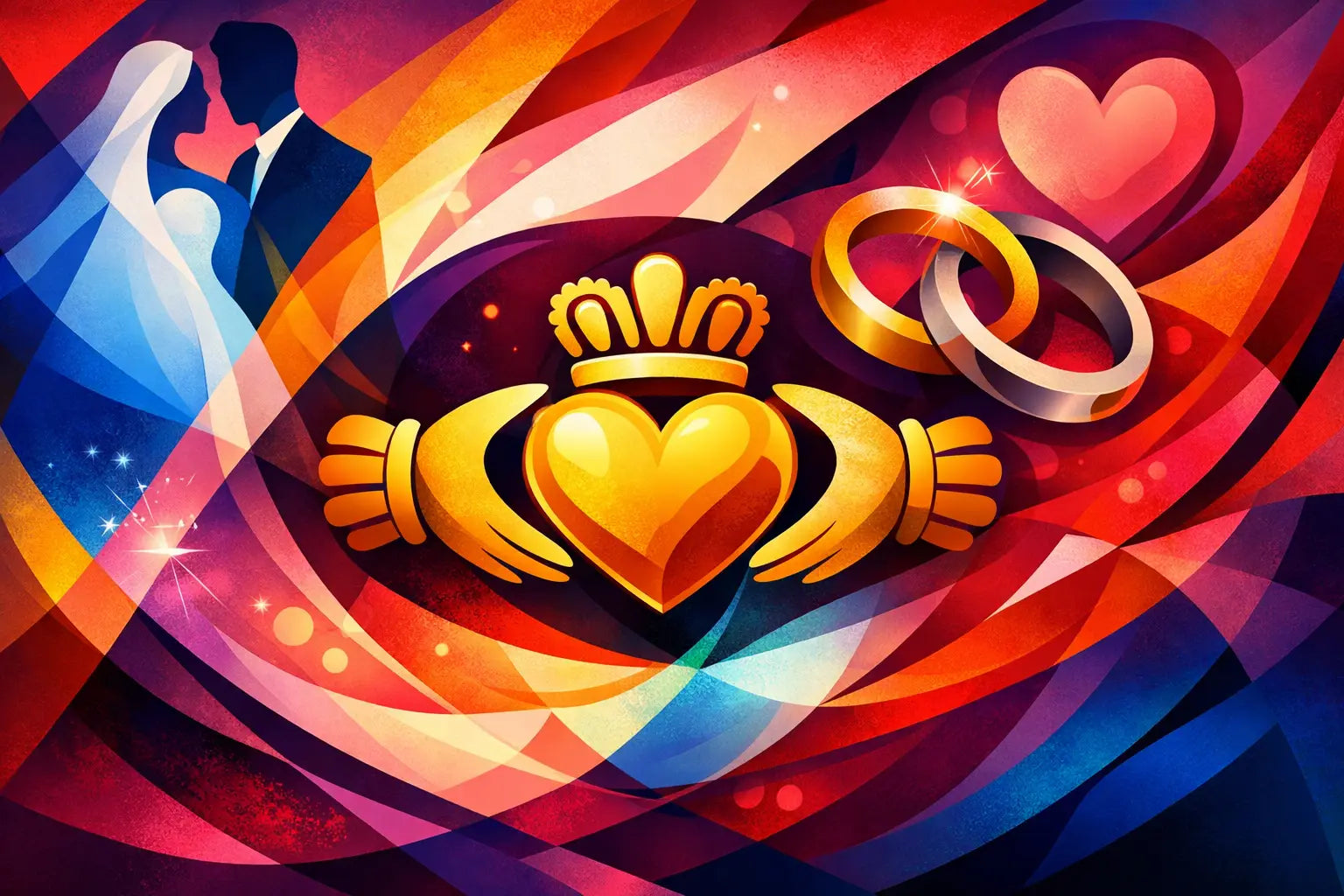
A wedding ring does more than complete the look. It carries a promise, a history and, for many couples, a visible sense of where they come from. So, does Claddagh jewellery suit weddings? Absolutely - when it means something to the people wearing it. The Claddagh is not decoration borrowed for a theme. It is an Irish symbol of love, loyalty and friendship, worn with intention.
For couples with Irish roots, a Claddagh ring or necklace can make a ceremony feel less like a set of trends and more like their own. For anyone drawn to its meaning, it offers the same thing: jewellery with a story strong enough to outlast one day of photographs.
Does Claddagh Jewellery Suit Weddings?
Yes, but the best answer is more interesting than a simple yes. Claddagh jewellery works beautifully for weddings because its symbolism already speaks the language of commitment. Two hands hold a heart, topped with a crown. Friendship holds love. Loyalty protects it. That is a far better starting point than choosing a piece simply because it matches the tablescape.
A Claddagh ring can be an engagement ring, a wedding ring, a gift between partners, or a piece worn by the wedding party. A pendant can sit close to the heart beneath a dress or open-collared shirt. Earrings can bring the symbol into a bridal look without competing with the rings. There is no single correct way to make it part of the day.
What matters is proportion and purpose. A large, highly detailed ring may be ideal as a statement piece but less practical as the band worn every day. A clean silver Claddagh with restrained detail can feel sharp, modern and easy to live in. Heritage does not need to look costume-like. It can look considered.
The Meaning Gives It Weight
The Claddagh comes from the fishing village of Claddagh in Galway and has become one of Ireland's most recognised symbols. Its popularity is not accidental. The design says something clear without needing a speech: love, friendship and loyalty belong together.
That makes it especially fitting for a wedding. Marriage is not only the grand declaration. It is the ordinary, lasting work of choosing one another, showing up and staying loyal when life becomes less polished. A Claddagh carries that quieter truth.
For diaspora couples, it can also create a connection across distance and generations. Perhaps a grandparent wore one. Perhaps Ireland is part of the family story, even if the ceremony is taking place in London, Manchester or far beyond these islands. Worn well, it is not a souvenir. It is a marker of belonging.
Of course, Irish heritage is not a requirement. The symbol's meaning is open to anyone who respects it and feels connected to what it represents. The strongest choice is always personal, not performative.
Choosing a Claddagh Ring for the Ceremony
If the Claddagh will be your actual wedding band, think beyond the ceremony. You will wear it while making tea, travelling, working and getting through every ordinary Tuesday. Choose a metal, shape and finish that suit your life, not only the wedding outfit.
Silver has a crisp, understated feel and works brilliantly with contemporary tailoring, minimalist bridalwear and cooler-toned accessories. Gold brings warmth and traditional ceremony, particularly alongside champagne, ivory or deep green details. A mixed-metal look can be striking, though it is worth checking that it sits comfortably beside an engagement ring or existing everyday jewellery.
The profile matters as much as the design. A high-set crown, raised heart or very ornate hands may catch on clothing and sit awkwardly against another ring. A flatter, more streamlined Claddagh is often the easier choice for daily wear. If you are stacking rings, try the combination before the big day. What looks balanced in a jewellery box can feel crowded on the hand.
Sizing deserves attention too. Hands can swell with heat, nerves, travel and a glass of celebratory fizz. Have the ring fitted properly, ideally well before the ceremony, and avoid last-minute assumptions based on an old ring size.
Ring direction: tradition, not a test
Claddagh ring etiquette is part of the charm, but it should never become wedding-day pressure. Traditional interpretations vary by region and family, particularly around which hand is used and whether the heart faces towards or away from the wearer. Often, the direction is read as a sign of whether the heart is available, taken or committed.
If this tradition matters to you, ask family members how they understand it and follow the version that feels right. If it does not, wear the ring in the way that is comfortable and meaningful to you. A wedding is not an exam in cultural correctness. It is a commitment made on your terms.
Styling Claddagh Jewellery Without Going Overboard
The Claddagh is expressive enough to stand alone. That is its strength. A wedding look does not need a matching Celtic motif on every surface to feel Irish or meaningful.
For a bride wearing a Claddagh ring, keep other hand jewellery restrained so the symbol remains visible. A simple bracelet, fine chain or small earrings can add polish without turning the look into a display case. If the dress has intricate lace, beading or a detailed neckline, a smaller ring or delicate pendant usually creates a cleaner balance.
For grooms and non-traditional wedding looks, a Claddagh ring pairs naturally with a sharp suit, an open-neck shirt, a modern blazer or even a refined jersey-inspired detail at the after-party. The point is not to dress like a historical re-enactment. Let one meaningful piece carry the heritage, then wear the rest with confidence.
A Claddagh pendant is a strong alternative when a ring is not practical. Some people do not like rings, work with their hands, or already have an engagement and wedding stack that feels complete. A pendant can be worn during the ceremony and kept as an everyday piece afterwards. It also makes a thoughtful gift from one partner to another, or from parents to a child on the morning of the wedding.
When a Claddagh May Not Be the Right Choice
Meaningful jewellery should not be chosen out of obligation. If neither partner feels a connection to the symbol, forcing it into the wedding can make it feel like a prop. The same applies if you want a very plain band and know an ornate design will frustrate you after a few weeks.
There are practical considerations as well. Some Claddagh designs are too detailed to sit flush with certain engagement rings. Others may need more careful cleaning than a smooth band. If you are planning an active honeymoon, work in a hands-on role or simply dislike the feel of jewellery, a pendant, engraved keepsake or a Claddagh piece reserved for occasions may be a better fit.
The tradition should add something, not ask you to become someone else. That is the line worth holding.
Make It Part of the Story, Not Just the Outfit
The most powerful way to wear Claddagh jewellery at a wedding is to give it a place in the story. It might be a ring exchanged during the vows, a family piece passed down before the ceremony, or a new design chosen together as a future heirloom. You can mention its meaning in a reading, keep it private between the two of you, or let the symbol speak without explanation.
For couples who want heritage with a modern edge, that balance is the whole point. EIRIN pieces are made for people who wear Irish identity as something living, not something kept behind glass. Clean styling lets the message land: pride, love and loyalty, without the cliché.
Choose the Claddagh because it says what you want your marriage to stand for. Then wear it your way - with history on your hand and your own future in front of you.


![Eirin Apparel Claddagh Earrings Chunky Gold-Plated Claddagh Hoop Earrings – 'Soláis' (Sunlight) [collection-cover-only]](http://eirin.co/cdn/shop/files/eirin-apparel-claddagh-earrings-chunky-gold-plated-claddagh-hoop-earrings-solais-sunlight-1260024173.png?v=1790378984&width=1254)

![Eirin Apparel Claddagh Earrings Chunky Silver-Plated Claddagh Hoop Earrings – 'Réalta' (Starlight) [collection-cover-only]](http://eirin.co/cdn/shop/files/eirin-apparel-claddagh-earrings-chunky-silver-plated-claddagh-hoop-earrings-realta-starlight-1260024174.png?v=1790378955&width=1254)

![Eirin Apparel Claddagh Earrings Dainty Gold-Plated Claddagh Hoop Earrings – 'Gríanóg' (Little Sun) [collection-cover-only]](http://eirin.co/cdn/shop/files/eirin-apparel-claddagh-earrings-dainty-gold-plated-claddagh-hoop-earrings-grianog-little-sun-1260024172.png?v=1790379015&width=2048)

![Eirin Apparel Claddagh Earrings Gold-Plated Sterling Silver Claddagh Earrings – ‘Croi Óir’ (Golden Heart) [collection-cover-only]](http://eirin.co/cdn/shop/files/eirin-apparel-claddagh-earrings-gold-plated-sterling-silver-claddagh-earrings-croi-oir-golden-heart-1260024175.png?v=1790378802&width=2048)

![Eirin Apparel Claddagh Earrings Celtic Knot Claddagh Earrings – ‘Fáinne an Ghrá’ (Ring of Love) [collection-cover-only]](http://eirin.co/cdn/shop/files/eirin-apparel-claddagh-earrings-celtic-knot-claddagh-earrings-fainne-an-ghra-ring-of-love-1260024176.png?v=1790378776&width=2048)

![Eirin Apparel Women's Earrings Women's Irish Harp Earrings – 'Fuaim' (Sound) [collection-cover-only]](http://eirin.co/cdn/shop/files/eirin-apparel-women-s-earrings-women-s-irish-harp-earrings-fuaim-sound-1260024177.png?v=1790378295&width=2048)


![Eirin Apparel Claddagh Ring Women's Gold-Plated Classic Claddagh Ring – ‘Gréine’ (Of the Sun) [collection-cover-only]](http://eirin.co/cdn/shop/files/eirin-apparel-claddagh-ring-women-s-gold-plated-classic-claddagh-ring-greine-of-the-sun-1260024155.png?v=1790378897&width=1254)

![Eirin Apparel Claddagh Ring Women's Silver-Plated Classic Claddagh Ring – ‘Gealaí’ (Moonlight) [collection-cover-only]](http://eirin.co/cdn/shop/files/eirin-apparel-claddagh-ring-women-s-silver-plated-classic-claddagh-ring-gealai-moonlight-1260024154.png?v=1790378925&width=2048)

![Eirin Apparel Claddagh Ring Women’s Two-Tone Claddagh Ring – ‘Síorghrá’ (Eternal Love) [collection-cover-only]](http://eirin.co/cdn/shop/files/eirin-apparel-claddagh-ring-women-s-two-tone-claddagh-ring-siorghra-eternal-love-1260024158.png?v=1790378653&width=1254)

![Eirin Apparel Claddagh Ring Women’s Chunky Claddagh Ring – 'Dílse' (Faithful) [collection-cover-only]](http://eirin.co/cdn/shop/files/eirin-apparel-claddagh-ring-women-s-chunky-claddagh-ring-dilse-faithful-1260024159.png?v=1790378561&width=1254)

![Eirin Apparel Women's Ring Women's Celtic Knot Ring – 'Síorfhite' (Everwoven) [collection-cover-only]](http://eirin.co/cdn/shop/files/eirin-apparel-women-s-ring-women-s-celtic-knot-ring-siorfhite-everwoven-1260024160.png?v=1790378476&width=1254)


