

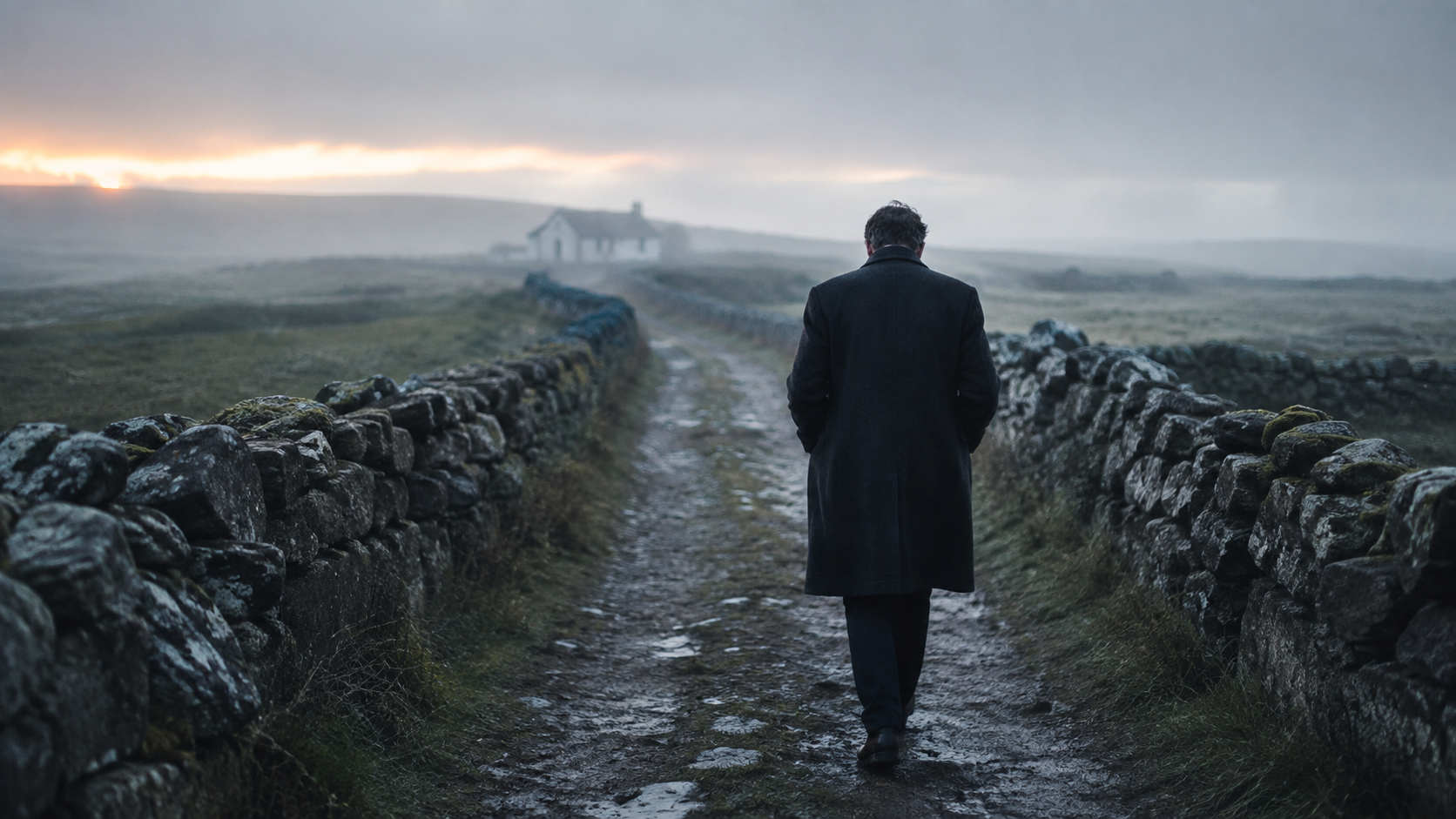
There is a room in a cottage somewhere in your family's past that you have never seen.
It is full of people. There is music, and there is food that the household could not really afford, and there is a young person sitting in the middle of it who will get on a cart before dawn. The neighbours have come to say goodbye. Some of them are crying the way you cry at a funeral, because in every way that matters, this is one. They will not see this person again.
The Irish had a name for that night. They called it an American wake.
That room is the beginning of most diaspora stories — the moment the line between Ireland and everywhere else was drawn straight through the middle of a family. But the reasons that young person was leaving stretch back centuries before them, and forward for a century and a half after.
Here is the part that startles most people: Ireland's population today is still smaller than it was in 1841. The census taken that year counted around 8.2 million people on the island. Today, north and south together, it is roughly 7.1 million. Nearly two centuries have passed. Ireland has not yet grown back.
Everything below is the explanation for that sentence.

Ireland Was Already Leaving
The Famine did not invent Irish emigration. It accelerated something that had been happening for generations, and it changed its character permanently — but the road out of Ireland was already well worn.
In September 1607, Hugh O'Neill, Earl of Tyrone, and Rory O'Donnell, Earl of Tyrconnell, boarded a ship at Rathmullan on the shore of Lough Swilly and sailed for the Continent with around ninety followers. They never came back. The Flight of the Earls is usually taught as the end of the Gaelic aristocratic order in Ulster, and it was. It was also, in a real sense, the first famous Irish departure — the moment the pattern was set of Irish leadership, and then Irish people, seeking a future somewhere other than Ireland.
Then came the soldiers. After the Williamite War ended with the Treaty of Limerick in 1691, Patrick Sarsfield led thousands of Irish troops into the service of France. They are remembered as the Wild Geese, and for the next hundred years Irish regiments fought in the armies of France, Spain and Austria. Their most storied day was Fontenoy in 1745, where the Irish Brigade helped break a British-led advance. Irish surnames took root in French and Spanish military rolls, and later in the aristocracies of both countries.
Meanwhile, a quieter and much larger movement was under way in Ulster. From around 1717, Presbyterian families — mostly of Scottish descent, generations settled in the north of Ireland — began leaving for the American colonies in significant numbers. They were pushed by rising rents, downturns in the linen trade, and legal disabilities placed on Presbyterians as well as Catholics. Estimates suggest something in the region of a quarter of a million left Ulster for America during the eighteenth century. They pushed inland and settled the Appalachian backcountry, and their descendants are known in America as the Scotch-Irish. Andrew Jackson's parents emigrated from near Carrickfergus. Ulster's fingerprints are on the founding of the United States in ways that are rarely acknowledged on either side of the Atlantic.
There is one more strand of the pre-Famine story that deserves handling honestly. In the 1650s, following the Cromwellian conquest, thousands of Irish people — prisoners of war, the dispossessed, the destitute — were forcibly transported to Barbados, Montserrat and other Caribbean colonies as indentured labourers. It was brutal, it was coerced, and it is a real part of Irish history. It was not, however, chattel slavery, and it is worth saying plainly that the "Irish slaves" story circulating online — which claims Irish people were enslaved on the same terms as Africans — is a distortion that historians have repeatedly and thoroughly refuted. Indentured servitude, however violent, was time-limited and did not make a person or their children property for life. Our history is harrowing enough without borrowing someone else's.
So: four hundred years ago, the Irish were already going. What changed in the 1840s was the scale, and the finality.

An Gorta Mór
The potato blight reached Ireland in 1845. Phytophthora infestans turned a field of healthy plants into black rot in days, and it returned in 1846, and again — after a partial reprieve — in 1848 and 1849.
The blight was a natural disaster. What followed was not.
By the 1840s, a large share of the Irish rural poor depended on the potato almost totally for food. That dependence was the product of a land system in which the majority of the population were tenants and labourers working ground owned by someone else, subdivided into plots too small to grow anything else in sufficient quantity. When the potato failed, they had nothing to fall back on, and no money to buy alternatives.
Food continued to leave Ireland. Grain, butter, cattle and pork were shipped out of Irish ports — most heavily in the first year of the crisis, before the scale of it was understood. This is one of the details that still causes real anger, and it should. Historians debate the net balance carefully — from 1847 onwards, imports of maize into Ireland did exceed grain exports — but the fact remains that in the opening phase of a catastrophic famine, laden ships sailed out of a starving country.
The relief effort was shaped by the economic orthodoxy of the day, which held that markets should not be interfered with and that the poor should not be given something for nothing. Sir Robert Peel's government imported Indian corn in 1845–46. His successors under Lord John Russell moved to public works schemes — hungry, weakened people building roads to nowhere in a winter that was among the coldest on record — then to soup kitchens in 1847, then, disastrously, to placing the burden of relief on Irish poor rates in the same year. Charles Trevelyan, the Treasury official who administered much of it, wrote of the calamity in terms that read now as almost incomprehensibly cold.
One provision did more damage than most. The Gregory Clause of 1847 made anyone holding more than a quarter-acre of land ineligible for relief. It meant a family had to give up their holding to eat. Landlords used it, and mass evictions followed — houses tumbled, roofs pulled down so they could not be reoccupied, families put out on the road.
Roughly a million people died of starvation and of the diseases that follow it. Roughly another million left. Ireland lost around a quarter of its population in six years.
The ships they left on earned the name coffin ships, and 1847 — Black '47 — was the worst of it. On the St Lawrence River, the quarantine station at Grosse Île in Quebec was overwhelmed by vessels arriving from Ireland with typhus aboard. Thousands died there and were buried on the island. The memorial that stands there today is one of the most affecting places in the entire diaspora, precisely because so many of the people beneath it are unnamed.

The Century That Followed
Here is what the standard telling gets wrong. If the Famine had been a single catastrophic event, Ireland's population would have fallen sharply and then recovered, the way populations do.
It didn't. It kept falling — for another eighty years.
Between 1851 and 1921, something in the order of four and a half million people left Ireland. Emigration stopped being a crisis response and became the structure of ordinary Irish life. It was built into how families worked.
The mechanism was land. After the Famine, the practice of subdividing farms among all the children ended, and holdings began to pass intact to a single son. That kept farms viable — and it meant that every other child in the house had no future on it. Daughters needed a dowry to marry into another farm, and most families could fund at most one. Sons who were not the heir had, essentially, three options: stay unmarried on the family land as an unpaid labourer, take a religious vocation, or go.
Most went. Marriage ages in Ireland climbed to among the highest in Europe and the rate of permanent celibacy along with them, because emigration had become the recognised path for the children a farm could not carry.
Two features of this era make Irish emigration genuinely distinctive, and they are worth knowing.
It was extraordinarily female. Across most European emigrations of the period, men left first and in far greater numbers, sending for wives later. Ireland was close to an even split, and in some decades women outnumbered men. Young single Irish women crossed the Atlantic alone in enormous numbers, many going into domestic service in American households. They earned their own wages, chose their own moment to marry, and sent money home. If your family's American story starts with a great-great-grandmother rather than a great-great-grandfather, that is not unusual. That is the pattern.
It funded itself. Irish emigrants sent home staggering sums, and a large portion of that money bought the passage for the next sibling out. Prepaid tickets crossed the Atlantic westward, one after another, until whole townlands had been reassembled in specific American neighbourhoods and specific English cities. That is why the Irish abroad clustered so tightly. Nobody emigrated randomly. You went where your cousin already was, because your cousin had paid for the ticket.

The American Wake
The night before the leaving, the neighbours came.
The custom of the American wake — also called a live wake, or a convert wake, and known by different names in different counties — was exactly what it sounds like. There was food and drink beyond what the family could sensibly afford. There was music and dancing until first light. And there was grief performed in the same register as death, sometimes including keening, the ritual lament sung over the dead in the Irish tradition.
It was not melodrama. It was accurate. Before cheap air travel, a passage to America was one-way for most people. A woman leaving Connemara in 1885 was not making a decision she could revisit. Her mother was watching her walk out of the house for the last time and both of them knew it. Holding a funeral was the only honest response available.
At dawn, someone — usually a parent — walked the emigrant to the edge of the townland and stopped at an agreed spot. That point was sometimes called the bóithrín of tears, and in some places the specific bend in the road is still known.
If you want to understand what the diaspora carries in its bones, it is that: the door, the road, and the not-looking-back.

The Men Who Built Britain
Independence in 1922 did not stop the ships. In some ways it made them worse, because the new state was poor, agricultural and short of work.
The 1950s were the worst decade the Republic experienced in the twentieth century. Net emigration in that ten years ran to something over 400,000 people out of a population of under three million. By the 1961 census, the Republic's population had fallen to around 2.8 million — the lowest ever recorded. Independent Ireland was emptying faster than it had under the Union.
Most of them went to Britain, and a great many of them built it. Irish labourers — navvies — dug the tunnels, laid the motorways, poured the concrete for the postwar reconstruction of English cities. They lived in lodging houses in Kilburn, Cricklewood, Camden, Digbeth, Ancoats. They were the subject of the ballad "McAlpine's Fusiliers", and of Donall Mac Amhlaigh's memoir of the navvy life. Signs in windows telling the Irish not to apply were within living memory, and the men who remember them are still alive.
Then the 1980s. Recession, unemployment over seventeen per cent, and another 200,000 gone — many of them, this time, educated. A generation of Irish graduates arrived in New York and Boston without papers and worked in bars and on building sites as undocumented immigrants, until the Donnelly and Morrison visa programmes of 1987 and 1990 regularised a portion of them.
And then, when it seemed the pattern had finally broken — the Celtic Tiger years actually reversed the flow, and for the first time in modern history people came home — the crash of 2008 sent tens of thousands out again, this time towards Australia, Canada and the Gulf.
Four hundred years. Every generation. Almost without exception.

What the Leaving Made
It made about seventy million of us.
That figure — the commonly cited estimate of people worldwide who claim Irish descent — is worth sitting with. It is more than ten times the population of the island itself. Around thirty million Americans record Irish ancestry. Roughly a third of Australians claim some Irish descent, a legacy that runs from transported convicts through the gold rushes to Ned Kelly's Tipperary parents. Canada's connection was forged in the fever sheds of Grosse Île and in the timber ports of New Brunswick. In Argentina, hundreds of thousands descend from Irish settlers, and the founder of the Argentine navy, Admiral William Brown, was born in Foxford, County Mayo.
Ireland is one of very few countries on earth whose story is genuinely bigger outside its borders than within them.
And here is the thing that we should be clear about, because it gets said carelessly. Those seventy million people are not a watered-down version of Irishness. They are what Irishness did. The music survived in Chicago and Boston when it was thin on the ground at home. The language was kept up in New York halls. The customs, the sports, the saints' days, the sean-nós, the storytelling — much of it was carried out of Ireland in the heads of people who owned nothing else and was maintained abroad with a fierceness that the people who stayed did not always need to summon.
You do not need a Dublin postcode to be part of that. You need a line — and if you are reading this, you have one. Someone in your family stood in a doorway.

Carry It Forward
At Eirin, this is the whole reason we exist. We are not interested in the tourist version of Ireland, the plastic shamrock, the novelty jumper. We are interested in the real thing: a culture that survived removal, and the seventy million people who are still holding on to it from four thousand miles away.
That is what The Eirin Clan is built for. When you join, you join by where you are in the world — Ireland, England, Scotland, Wales, the USA, Canada, Australia, or Clan Worldwide — because the place your people landed is part of your story too. Boston is not New York. Liverpool is not Glasgow. Each of those journeys had its own shape, and we tell each of them properly.
Your ancestors did not get to choose whether they left. You get to choose whether you claim it.


![Eirin Apparel Claddagh Earrings Chunky Gold-Plated Claddagh Hoop Earrings – 'Soláis' (Sunlight) [collection-cover-only]](http://eirin.co/cdn/shop/files/eirin-apparel-claddagh-earrings-chunky-gold-plated-claddagh-hoop-earrings-solais-sunlight-1260024173.png?v=1790378984&width=1254)

![Eirin Apparel Claddagh Earrings Chunky Silver-Plated Claddagh Hoop Earrings – 'Réalta' (Starlight) [collection-cover-only]](http://eirin.co/cdn/shop/files/eirin-apparel-claddagh-earrings-chunky-silver-plated-claddagh-hoop-earrings-realta-starlight-1260024174.png?v=1790378955&width=1254)

![Eirin Apparel Claddagh Earrings Dainty Gold-Plated Claddagh Hoop Earrings – 'Gríanóg' (Little Sun) [collection-cover-only]](http://eirin.co/cdn/shop/files/eirin-apparel-claddagh-earrings-dainty-gold-plated-claddagh-hoop-earrings-grianog-little-sun-1260024172.png?v=1790379015&width=2048)

![Eirin Apparel Claddagh Earrings Gold-Plated Sterling Silver Claddagh Earrings – ‘Croi Óir’ (Golden Heart) [collection-cover-only]](http://eirin.co/cdn/shop/files/eirin-apparel-claddagh-earrings-gold-plated-sterling-silver-claddagh-earrings-croi-oir-golden-heart-1260024175.png?v=1790378802&width=2048)

![Eirin Apparel Claddagh Earrings Celtic Knot Claddagh Earrings – ‘Fáinne an Ghrá’ (Ring of Love) [collection-cover-only]](http://eirin.co/cdn/shop/files/eirin-apparel-claddagh-earrings-celtic-knot-claddagh-earrings-fainne-an-ghra-ring-of-love-1260024176.png?v=1790378776&width=2048)

![Eirin Apparel Women's Earrings Women's Irish Harp Earrings – 'Fuaim' (Sound) [collection-cover-only]](http://eirin.co/cdn/shop/files/eirin-apparel-women-s-earrings-women-s-irish-harp-earrings-fuaim-sound-1260024177.png?v=1790378295&width=2048)


![Eirin Apparel Claddagh Ring Women's Gold-Plated Classic Claddagh Ring – ‘Gréine’ (Of the Sun) [collection-cover-only]](http://eirin.co/cdn/shop/files/eirin-apparel-claddagh-ring-women-s-gold-plated-classic-claddagh-ring-greine-of-the-sun-1260024155.png?v=1790378897&width=1254)

![Eirin Apparel Claddagh Ring Women's Silver-Plated Classic Claddagh Ring – ‘Gealaí’ (Moonlight) [collection-cover-only]](http://eirin.co/cdn/shop/files/eirin-apparel-claddagh-ring-women-s-silver-plated-classic-claddagh-ring-gealai-moonlight-1260024154.png?v=1790378925&width=2048)

![Eirin Apparel Claddagh Ring Women’s Two-Tone Claddagh Ring – ‘Síorghrá’ (Eternal Love) [collection-cover-only]](http://eirin.co/cdn/shop/files/eirin-apparel-claddagh-ring-women-s-two-tone-claddagh-ring-siorghra-eternal-love-1260024158.png?v=1790378653&width=1254)

![Eirin Apparel Claddagh Ring Women’s Chunky Claddagh Ring – 'Dílse' (Faithful) [collection-cover-only]](http://eirin.co/cdn/shop/files/eirin-apparel-claddagh-ring-women-s-chunky-claddagh-ring-dilse-faithful-1260024159.png?v=1790378561&width=1254)

![Eirin Apparel Women's Ring Women's Celtic Knot Ring – 'Síorfhite' (Everwoven) [collection-cover-only]](http://eirin.co/cdn/shop/files/eirin-apparel-women-s-ring-women-s-celtic-knot-ring-siorfhite-everwoven-1260024160.png?v=1790378476&width=1254)


