

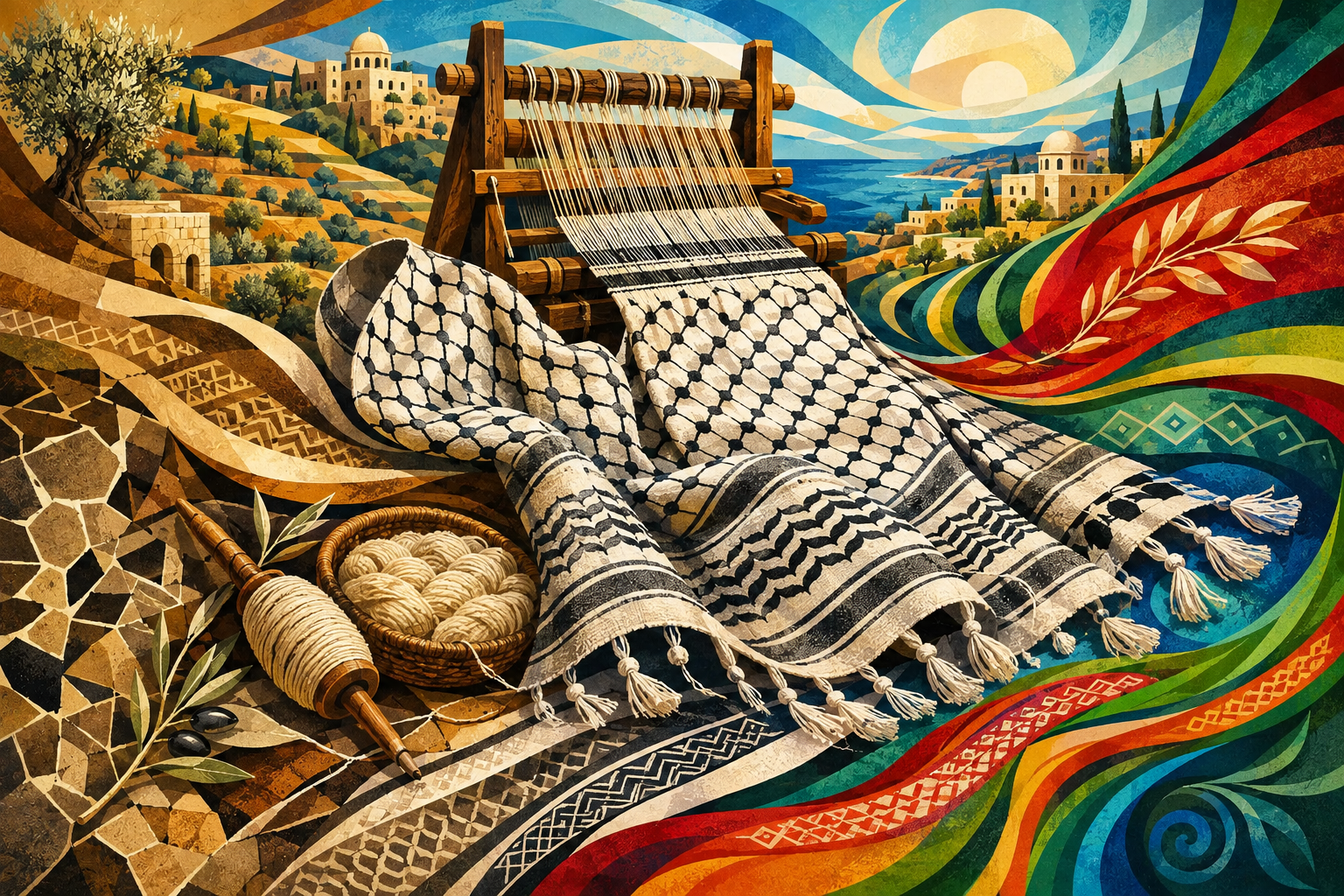
The keffiyeh is one of the most recognisable garments in the Middle East—and one of the most misunderstood. Online debates often claim that Palestinians “stole” the keffiyeh, or that it does not truly belong to them.
This article addresses that claim directly, clearly, and historically—without academic jargon or political posturing.

What Is a Keffiyeh?
A keffiyeh is a square cotton scarf traditionally worn across the Arab world. Long before it carried political meaning, it was purely functional.
Historically, it was worn to:
- Protect from sun, dust, and sand
- Provide warmth during cold desert nights
- Absorb sweat in hot climates
It was everyday workwear, especially among rural communities.
Where Did the Keffiyeh Originate?
The keffiyeh did not originate in a modern country.
Similar head coverings existed across the Middle East centuries before modern borders, including Mesopotamia, the Arabian Peninsula, and the Levant. At the time, the region—including what we now call Palestine—was governed under the Ottoman Empire.
There was no concept of national ownership of clothing. Cultural styles moved freely across towns, villages, and trade routes.

Who Traditionally Wore the Keffiyeh?
Across the Levant, the keffiyeh was worn mainly by rural Arab farmers.
In Palestine specifically:
- Rural Palestinians commonly wore the keffiyeh
- Urban elites often wore the fez (tarboosh)
This distinction matters—because the keffiyeh later became a symbol of unity across social classes.
How Did the Keffiyeh Become a Palestinian Symbol?
During the 1936–1939 Arab Revolt against British colonial rule, Palestinian rebels were often identified by their clothing. In response, urban Palestinians abandoned the fez and adopted the keffiyeh, deliberately aligning themselves with rural resistance fighters.
From that point on, the keffiyeh represented:
- Unity
- Resistance
- Palestinian identity
It became a national symbol through history, not appropriation.

Is the Keffiyeh Exclusively Palestinian?
No—and Palestinians have never claimed it was.
The keffiyeh is worn across many Arab societies, including Jordan, Iraq, and Saudi Arabia. Shared culture is not cultural theft.
What makes the keffiyeh distinctly Palestinian is how deeply it is tied to Palestinian history, struggle, and lived experience.
Why the Black-and-White Keffiyeh?
The black-and-white keffiyeh became internationally associated with Palestinians in the 20th century, particularly through figures like Yasser Arafat.
Its pattern is often interpreted as symbolising:
- Connection to land and labour
- Endurance and resilience
- Collective resistance
Whether symbolic or practical, it became inseparable from Palestinian identity.

So—Did Palestinians “Steal” the Keffiyeh?
No. This claim is historically false.
The keffiyeh:
- Existed long before modern nation-states
- Was worn by Palestinians for generations
- Became a Palestinian symbol through resistance and history
- Is part of a broader regional culture, not owned by one state
Palestinians did not “steal” the keffiyeh. They lived in it, worked in it, resisted in it—and carried its meaning forward.
Why This Still Matters
The keffiyeh is controversial today because symbols matter. For Palestinians, it represents heritage, memory, and survival. Understanding that does not require taking sides—only acknowledging history as it is. And history is clear.


