Ask most people for a phrase in Irish and they’ll give you something living - a greeting, a county slogan, a line their grandparents used, a word they’ve seen on a jersey or T-shirt. That is where old irish vs modern irish gets real. This is not just a language lesson. It is the difference between a tongue forged in early medieval Ireland and the Irish people still speak, reclaim, wear and carry now.
Language changes because people do. Power shifts. Borders harden. Schools standardise. Speech survives anyway. Irish is no different. Old Irish belongs to a world of monks, oral tradition and law tracts. Modern Irish belongs to classrooms, Gaeltacht communities, music, protest, design and everyday identity. Same language family, same cultural line, but not the same system on the page or in the mouth.
What old Irish vs modern Irish really means
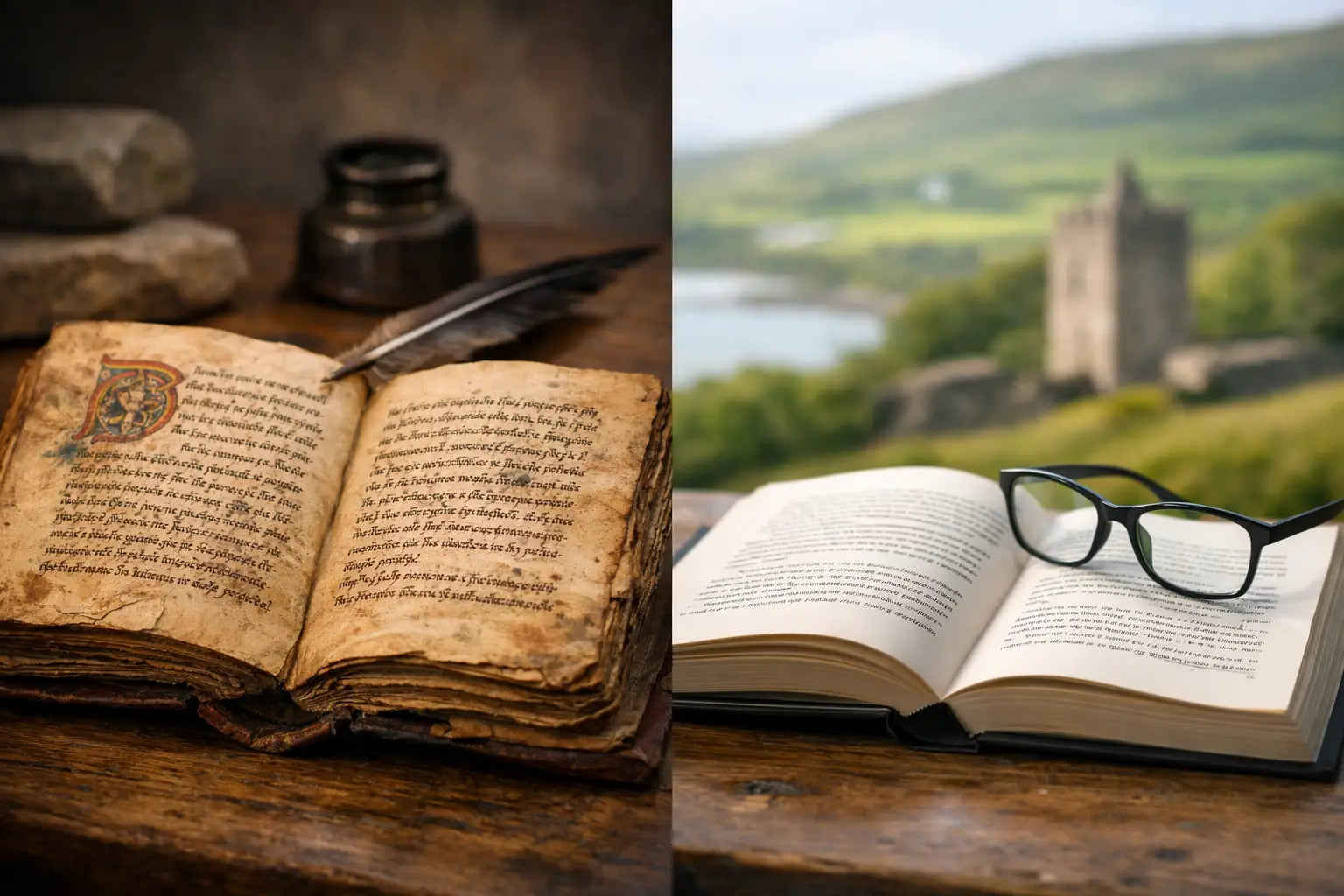
Old Irish usually refers to the form of the language used roughly from the 6th to the 10th century. It appears in glosses, religious texts and some of the earliest written evidence of Irish speech. Modern Irish refers to the language as it exists today, including the standard written form and the living dialects of Ulster, Connacht and Munster.
That gap is huge. If you are imagining the difference between slightly old-fashioned phrasing and current slang, think bigger. Old Irish is not just older vocabulary. Its grammar is denser, its spelling reflects an earlier sound system, and its sentence structures can feel foreign even to Irish speakers today. A fluent speaker of modern Irish would not simply pick up an Old Irish manuscript and read it with ease.
This matters because people often treat Irish as one fixed heritage object. It is not fixed. It never was. Irish survived by changing.
Old Irish was sharper, denser, more inflected
Old Irish carried far more grammatical marking than modern Irish. Nouns had fuller case systems. Verbs were packed with distinctions that later became simpler or disappeared. Pronouns and particles could attach in ways that make the language feel compact and highly engineered.
In plain terms, Old Irish often said more inside the word itself. Modern Irish still has rich grammar, but some of the older complexity has been levelled out over time. Endings reduced. Patterns merged. Constructions that were once standard became rare or vanished.
That does not mean modern Irish is watered down. It means it evolved towards the way real communities actually spoke. Languages shed weight and build new habits. That is not decline. That is survival.
You see this in verb forms especially. Old Irish had absolute and conjunct verb endings, a feature that makes students of historical Celtic sit up straight and everyone else wonder why one verb needs two personalities. Modern Irish no longer works that way. The system became more direct, even if plenty of irregularity still keeps learners humble.
Sound changed, and spelling carried the scars
One of the biggest differences in old irish vs modern irish is sound. Over centuries, pronunciation shifted while writing often held on to older habits. That is why Irish spelling can look intimidating to outsiders. Much of it records historical sound changes and grammatical relationships rather than matching English-style expectations of one sound per letter.
Old Irish had sounds and sound contrasts that later developed into something else. Vowels shifted. Consonants softened or disappeared in certain positions. Some endings that were once pronounced clearly became weaker. Written forms then adapted slowly, unevenly, and often under the pressure of scribal convention.
Modern Irish spelling, while standardised, still shows the bones of older pronunciation. This is part of its character. It is also why Irish words on modern clothing, jewellery or signage can feel visually striking. They carry age in the letters, even when the phrase itself is fully current.
The vocabulary tells the story of Ireland itself
Old Irish vocabulary reflects the world that produced it - kinship, status, cattle, law, monastic learning and warfare. Modern Irish still carries some of that inheritance, but it also had to make room for modern life. Cities, technology, politics, migration, sport and global culture all demanded new language.
Some words survived with little change. Others shifted meaning. Many disappeared from everyday use. New borrowings arrived, especially through contact with Norse, Anglo-Norman and English. Irish did what every living language does: it absorbed pressure and answered back.
That is why modern Irish can hold both deep ancestry and present-day edge. You can have an ancient symbol like the Claddagh sitting beside a sharp contemporary slogan in Irish and neither feels fake. Heritage is not trapped in a museum case. It still speaks.
Modern Irish is not one voice
When people say modern Irish, they often mean the standard taught in schools. That is only part of the picture. Living Irish also exists in regional dialects, each with its own rhythm, pronunciation and preferred forms. Ulster Irish does not sound like Munster Irish. Connacht Irish is not simply a midpoint. Each carries its own local authority.
This is where things get interesting. The standard helps with education, publishing and broader communication. But dialects hold texture. They keep Irish rooted in place, family and community. If Old Irish shows us where the language came from, dialect Irish shows us how it stayed alive.
There is a trade-off here. Standardisation makes a language easier to teach at scale, but it can flatten regional difference. Dialect loyalty protects authenticity, but it can make learners feel unsure about what counts as correct. The truth is that both matter. A language needs reach, and it needs roots.
Why Old Irish still matters now
Old Irish is not useful only to specialists reading manuscripts in quiet archives. It matters because it proves how deep the linguistic line runs. It shows that Irish is not a decorative add-on to national identity. It is one of the oldest recorded vernacular languages in Europe.
That carries weight. Not polite heritage weight. Real weight. The kind that changes how you see a phrase on a wall, a ring, a cap or a jersey. When you wear Irish language or symbolism with intent, you are not borrowing a vibe. You are standing inside a much older story.
At the same time, old forms should not be fetishised as if age alone makes them purer. That is a trap. A language that only counts when it looks ancient is already being buried. Modern Irish matters because it is alive enough to argue, adapt, offend, flirt, chant and create.
Old Irish vs modern Irish in identity terms
The deeper argument in old irish vs modern irish is not which version is better. It is what kind of relationship people want with Irishness. Some people want origin, the oldest recoverable layer, the sense of untouched inheritance. Others want something wearable and current, language that can move through modern life without apology.
You do not have to choose one against the other. Old Irish gives depth. Modern Irish gives access. One tells you how long the road is. The other lets you walk it.
For the diaspora especially, that distinction matters. Not everyone has fluent Irish at home. Not everyone grew up in a Gaeltacht or studied the language deeply at school. But connection does not become fake because it starts in the present. A modern Irish word on a T-shirt, a phrase learned properly and spoken with respect, a piece of design that carries cultural meaning - these can be entry points, not shortcuts.
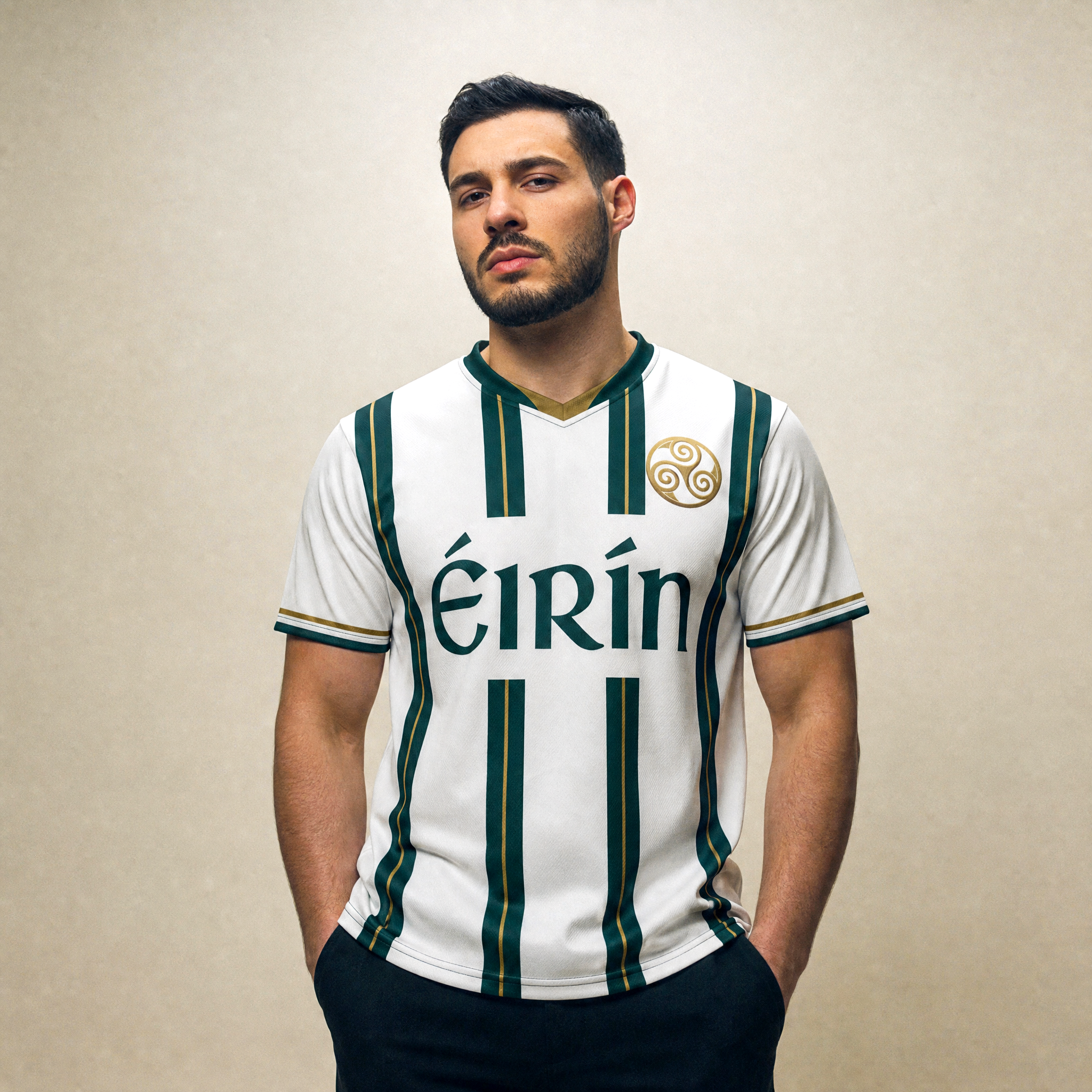
That is part of the point behind brands like EIRIN. Irish identity does not need to look dusty to be real. It can be sharp, stripped back and fully contemporary without cutting itself off from history.
So which Irish are people usually looking at?
If you see Irish on clothing, in music, on social media, in schools or in public life, you are almost always looking at modern Irish. If you are reading early medieval texts, studying historical linguistics or examining manuscript culture, you are dealing with Old Irish.
Confusion happens because both get labelled simply as Irish, and because many people assume an old-looking script or unfamiliar spelling must mean ancient language. Sometimes it does. Sometimes it is just standard modern Irish written by someone who knows what they are doing.
The safest way to think about it is this: Old Irish is an ancestor. Modern Irish is the living descendant. They belong to the same line, but they do not occupy the same moment.
If you care about Irish identity, that should feel less like a split and more like continuity with attitude. The language changed because Irish people kept carrying it through changing times. That is the real inheritance. Not preservation for its own sake, but survival with shape, sound and meaning intact enough to still be claimed.
So if you are drawn to Irish words, symbols and history, start where you are. Learn the modern form. Respect the older one. Wear the culture like you mean it, not like you are asking permission.