

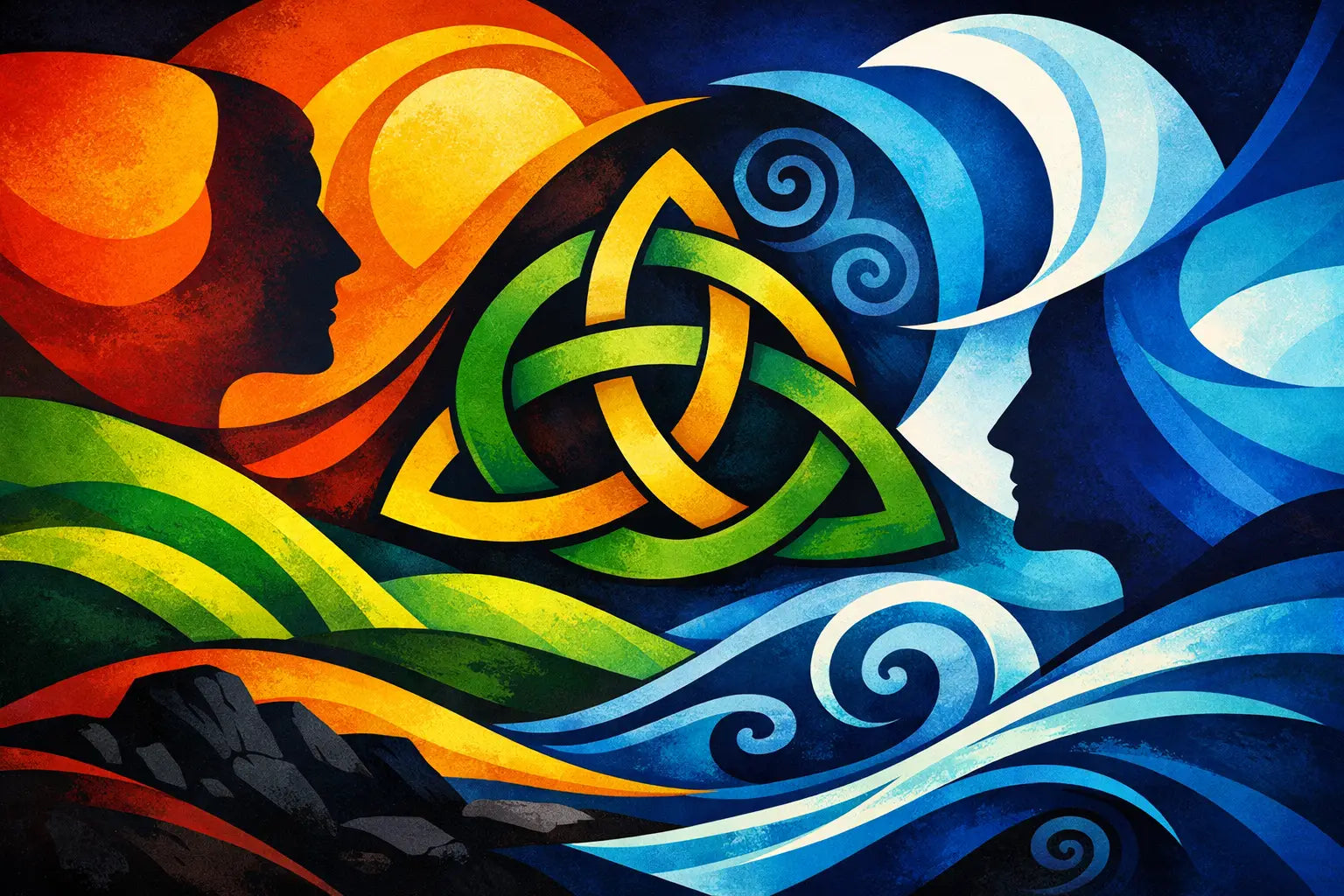
Ask ten people what Celtic means and you will get ten different answers. Ancient symbols. Folk music. Family names. Rugby shirts. A tattoo copied from a knotwork panel. That is exactly why modern Celtic identity matters. It is not a museum label. It is a live question - personal, political, stylish and, at times, contested.
For some, it begins with language. For others, with ancestry, land, migration or resistance. For plenty of people across Ireland, Scotland, Wales, Brittany, Cornwall and the wider diaspora, it is less about claiming a fixed category and more about carrying a cultural pulse into the present. Not costume. Not nostalgia. Something lived.
Modern Celtic identity is not one thing
Anyone looking for a neat definition will be disappointed. The old idea of a single, unified Celtic people has always been more complicated than souvenir-shop versions suggest. Historians, archaeologists and linguists all draw the boundaries differently. That does not make the identity fake. It makes it real in the way all living identities are real - layered, argued over and shaped by power.
In a modern sense, Celtic identity often refers to cultures linked by language families, shared histories of marginalisation, artistic traditions, oral memory and strong attachments to place. But those links do not erase difference. Irish identity is not Scottish identity. Welsh experience is not Breton experience. Cornwall is not the Highlands. The similarities matter, but so do the fractures.
That tension is part of the point. Modern Celtic identity is strongest when it refuses flattening. It can hold regional pride, national struggle, family memory and contemporary style at the same time.
Heritage without the costume
This is where a lot of people get it wrong. They treat Celtic identity as if it only counts when it looks old. Traditional music, old scripts, archaeological motifs, clan imagery - all of that has value. But culture does not stay alive by freezing itself.
A person wearing a clean graphic tee with Gaeilge on the chest may be expressing something every bit as authentic as someone playing a fiddle session in a village pub. A reworked flat cap, a Claddagh worn daily rather than saved for ceremony, or a jersey that nods to heritage without looking trapped in the past - these are not diluted forms. They are proof that identity adapts or it dies.
Style matters here because it makes culture visible in ordinary life. Not for performance. For presence. What you wear can say where you stand before you speak. It can reject the twee, tourist-friendly version of Celticness and replace it with something sharper, prouder and more current.
That is one reason brands like EIRIN resonate. The appeal is not novelty. It is recognition. Heritage that still has a pulse.
Language sits at the centre of modern Celtic identity
If there is one thread that keeps returning, it is language. Irish, Scottish Gaelic, Welsh, Breton and Cornish are not decorative remnants. They are living carriers of worldview, memory and belonging. Even when a person is not fluent, the pull of language can be strong. A single word can hold far more weight than a generic heritage slogan ever could.
But language also brings a trade-off. It can deepen connection, yet it can also make people feel excluded if they were raised away from it. That is especially true across the diaspora, where distance, assimilation and family silence often broke the chain. The answer is not gatekeeping. Nor is it pretending that a phrase on a hoodie is the same as speaking a language daily. It depends on honesty.
There is a difference between using language as a costume and using it as a point of return. One flattens culture. The other honours it. People can start where they are. A word learned. A name understood. A phrase worn with intent. Then more, if they choose.
The diaspora question
Diaspora identity is often treated unfairly. Some dismiss it as diluted. Others romanticise it so heavily that it becomes fantasy. The truth sits somewhere harder and more human.
For second- or third-generation people with Irish or other Celtic roots, identity may come through fragments - a grandmother's surname, songs at family events, stories about leaving, a sense of belonging that appears before the facts do. That can be powerful. It can also be uncertain.
Modern Celtic identity in the diaspora is often about rebuilding connection without pretending to be something you are not. There is nothing weak about that. If anything, it takes more effort. You have to sift myth from history, pride from caricature, inherited feeling from marketable cliché.
Done well, diaspora identity is not play-acting. It is active remembrance. It says: I know distance changed the story, but the story still matters.
Why politics still shapes the meaning
Celtic identity has never been only aesthetic. Across different nations and regions, it has been shaped by conquest, suppression, migration, revival and resistance. That does not mean every expression of Celticness must be overtly political. But pretending politics has nothing to do with it is naïve.
In Ireland especially, identity has long been tied to language loss, colonial pressure, rebellion and the fight to define Irishness on Irish terms. Similar pressures have existed elsewhere in different forms. So when people reclaim names, symbols, sport, language or dress, there is often more happening than taste.
That said, not every use of heritage symbolism is radical. Sometimes it is just personal. Sometimes it is family. Sometimes it is fashion first. Again, it depends. The point is that these meanings sit close to the surface. They are available, whether the wearer intends them or not.
Pride can be modern without asking permission
There is still a strange pressure around cultural expression. Keep it subtle. Keep it soft. Make it acceptable. Make it decorative. Modern Celtic identity pushes back on that instinct.
You do not need to perform neutrality to be taken seriously. You do not need to strip heritage of attitude to make it wearable. In fact, the most compelling expressions of identity often come from that exact refusal. They say culture is not something to apologise for. It is something to inhabit.
That does not require loudness for its own sake. Minimalist design can carry as much force as ornate symbolism. A clean line in Irish can hit harder than a page of explanation. Less noise. More conviction.
The problem with generic Celtic branding
The market has spent years selling Celtic identity as a blur of knots, crosses and vague mysticism. It is easy to see why people get cynical. Too much of it feels exported, flattened and stripped of context. Heritage turned into background pattern.
The issue is not the symbols themselves. Knotwork, Claddagh imagery, Ogham references and traditional forms all have meaning. The problem begins when they are used lazily, without place, intention or understanding. Then culture becomes styling. Recognisable, perhaps, but hollow.
Modern Celtic identity asks more. It wants context. It wants edge. It wants design that knows where it comes from and why it is being used now. This is where contemporary fashion has a real role. Good design can carry history forward without turning people into props.
What modern Celtic identity looks like now
It looks different depending on who is wearing it. For one person, it is speaking Irish with their children. For another, it is choosing jewellery with actual cultural meaning rather than generic trend pieces. For someone else, it is music, activism, sport, art, or simply refusing to let their background be edited out for comfort.
It can be urban. It can be rural. It can be mixed, global and in motion. It can live in Belfast, Glasgow, Cardiff, Cork, London, New York or Sydney. Place still matters, but place is no longer simple.
What connects these expressions is not purity. It is intent. A decision to carry heritage into contemporary life without diluting it into stereotype. To wear it, speak it, make it and pass it on in forms that still feel sharp now.
Where authenticity really comes from
People often talk about authenticity as if it means old, rare or untouched. Usually it means something else: coherence. Does the expression ring true? Does it come from knowledge, feeling or real connection? Or is it just surface?
No one gets this perfectly. Most people build identity in pieces. They inherit some parts, seek out others and question the rest. That process is not a weakness. It is how living cultures survive.
Modern Celtic identity is strongest when it leaves room for complexity. For the fluent speaker and the learner. For the person at home and the person returning. For tradition and reinvention. For pride without parody.
Wear it if it means something. Learn more if you can. Be honest about what you know and what you are still finding. Heritage does not need your performance. It needs your attention.


![Eirin Apparel Claddagh Earrings Chunky Gold-Plated Claddagh Hoop Earrings – 'Soláis' (Sunlight) [collection-cover-only]](http://eirin.co/cdn/shop/files/eirin-apparel-claddagh-earrings-chunky-gold-plated-claddagh-hoop-earrings-solais-sunlight-1260024173.png?v=1790378984&width=1254)

![Eirin Apparel Claddagh Earrings Chunky Silver-Plated Claddagh Hoop Earrings – 'Réalta' (Starlight) [collection-cover-only]](http://eirin.co/cdn/shop/files/eirin-apparel-claddagh-earrings-chunky-silver-plated-claddagh-hoop-earrings-realta-starlight-1260024174.png?v=1790378955&width=1254)

![Eirin Apparel Claddagh Earrings Dainty Gold-Plated Claddagh Hoop Earrings – 'Gríanóg' (Little Sun) [collection-cover-only]](http://eirin.co/cdn/shop/files/eirin-apparel-claddagh-earrings-dainty-gold-plated-claddagh-hoop-earrings-grianog-little-sun-1260024172.png?v=1790379015&width=2048)

![Eirin Apparel Claddagh Earrings Gold-Plated Sterling Silver Claddagh Earrings – ‘Croi Óir’ (Golden Heart) [collection-cover-only]](http://eirin.co/cdn/shop/files/eirin-apparel-claddagh-earrings-gold-plated-sterling-silver-claddagh-earrings-croi-oir-golden-heart-1260024175.png?v=1790378802&width=2048)

![Eirin Apparel Claddagh Earrings Celtic Knot Claddagh Earrings – ‘Fáinne an Ghrá’ (Ring of Love) [collection-cover-only]](http://eirin.co/cdn/shop/files/eirin-apparel-claddagh-earrings-celtic-knot-claddagh-earrings-fainne-an-ghra-ring-of-love-1260024176.png?v=1790378776&width=2048)

![Eirin Apparel Women's Earrings Women's Irish Harp Earrings – 'Fuaim' (Sound) [collection-cover-only]](http://eirin.co/cdn/shop/files/eirin-apparel-women-s-earrings-women-s-irish-harp-earrings-fuaim-sound-1260024177.png?v=1790378295&width=2048)


![Eirin Apparel Claddagh Ring Women's Gold-Plated Classic Claddagh Ring – ‘Gréine’ (Of the Sun) [collection-cover-only]](http://eirin.co/cdn/shop/files/eirin-apparel-claddagh-ring-women-s-gold-plated-classic-claddagh-ring-greine-of-the-sun-1260024155.png?v=1790378897&width=1254)

![Eirin Apparel Claddagh Ring Women's Silver-Plated Classic Claddagh Ring – ‘Gealaí’ (Moonlight) [collection-cover-only]](http://eirin.co/cdn/shop/files/eirin-apparel-claddagh-ring-women-s-silver-plated-classic-claddagh-ring-gealai-moonlight-1260024154.png?v=1790378925&width=2048)

![Eirin Apparel Claddagh Ring Women’s Two-Tone Claddagh Ring – ‘Síorghrá’ (Eternal Love) [collection-cover-only]](http://eirin.co/cdn/shop/files/eirin-apparel-claddagh-ring-women-s-two-tone-claddagh-ring-siorghra-eternal-love-1260024158.png?v=1790378653&width=1254)

![Eirin Apparel Claddagh Ring Women’s Chunky Claddagh Ring – 'Dílse' (Faithful) [collection-cover-only]](http://eirin.co/cdn/shop/files/eirin-apparel-claddagh-ring-women-s-chunky-claddagh-ring-dilse-faithful-1260024159.png?v=1790378561&width=1254)

![Eirin Apparel Women's Ring Women's Celtic Knot Ring – 'Síorfhite' (Everwoven) [collection-cover-only]](http://eirin.co/cdn/shop/files/eirin-apparel-women-s-ring-women-s-celtic-knot-ring-siorfhite-everwoven-1260024160.png?v=1790378476&width=1254)


