

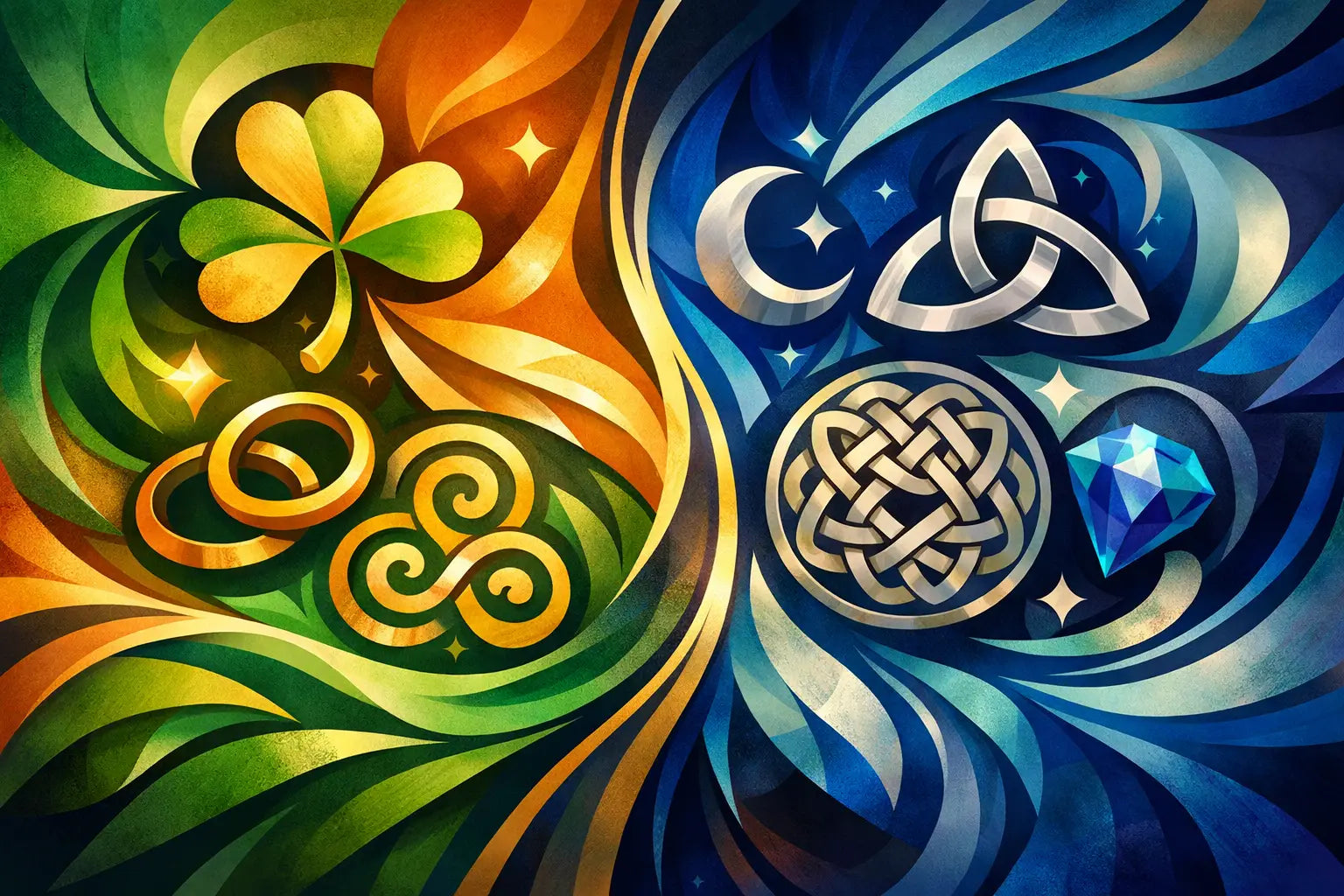
You have probably seen a knot ring called Irish, a Claddagh called Celtic, and a cross pendant labelled both. That is where the confusion starts. Irish vs Celtic jewellery is not a fake distinction, but it is not a clean split either. Some pieces are specifically Irish. Some are broadly Celtic. Some sit in both camps quite comfortably.
If you wear jewellery as more than decoration, the difference matters. It changes what a piece says about heritage, place and identity. And if you are buying with intent rather than picking up something that looks vaguely traditional, it helps to know what you are actually wearing.
Irish vs Celtic jewellery: the short answer
Celtic jewellery is the wider category. It draws from the visual traditions, symbols and artistic language associated with the Celtic peoples across places such as Ireland, Scotland, Wales, Cornwall, the Isle of Man and Brittany. Think knotwork, spirals, interlace, triskele forms and ancient motifs that pre-date the modern nation state.
Irish jewellery is narrower. It refers to jewellery rooted specifically in Irish history, Irish symbolism and Irish cultural identity. That might include designs like the Claddagh, Irish harp motifs, shamrocks, Ogham inscriptions or pieces tied directly to Irish craft traditions and storytelling.
So the easiest way to put it is this: not all Celtic jewellery is Irish, but a lot of Irish jewellery can also be Celtic.
That overlap is why labels get messy. Retailers often use the terms interchangeably because Celtic sounds recognisable and Irish feels emotionally direct. But if you care about meaning, provenance or personal connection, broad labels are not enough.
Where Celtic jewellery comes from
Celtic jewellery is built from an older visual language than most people realise. The word Celtic itself covers a range of peoples and cultures spread across parts of Europe over centuries. In jewellery, what survives most strongly is not a single national style but a family of motifs.
Knotwork is the one everyone knows. Endless loops without a visible start or finish suggest continuity, connection and eternity. Spirals and triskele forms often carry ideas of movement, life cycles and balance. Interlace patterns reflect the ornate manuscript and metalwork traditions that became especially distinctive in the early medieval period.
That means a piece can be Celtic without being uniquely Irish. A knot pendant may be inspired by Insular art more broadly. A triskele motif might evoke ancient Celtic symbolism without pointing to Ireland alone. If the design language is pan-Celtic, calling it Irish can be a stretch unless there is a clearer Irish reference built in.
What makes jewellery specifically Irish
Irish jewellery tends to carry a stronger sense of place. It is not just about old motifs. It is about symbols that are recognised as part of Ireland’s own cultural vocabulary.
The clearest example is the Claddagh. Hands for friendship, heart for love, crown for loyalty. It comes from Galway and has a specific Irish origin story, even if it is now worn all over the world. That makes it Irish first, and Celtic only second if the styling includes broader Celtic elements.
The harp is another example. It is not a generic heritage symbol. It is tied to Ireland in a direct and unmistakable way. The shamrock works similarly, though it can tip into cliché if handled badly. Ogham script also lands firmly in Irish territory because it comes from an early medieval alphabet associated with Ireland.
This is where design matters. A plain silver ring with Celtic knot engraving may be Celtic. A Claddagh ring with knot shoulders, Irish hallmarks or Ogham detail is clearly Irish and Celtic at the same time. Context sharpens identity.
Why the two are often blurred
Part of the problem is commercial. For years, heritage jewellery was marketed as a souvenir category. That encouraged broad labelling. Celtic became a catch-all for anything with knots or old-world styling, while Irish became shorthand for anything sold with green packaging or a shamrock nearby.
That approach strips out nuance. It also flattens culture into a generic aesthetic. For people with a real connection to Ireland, whether they live in Cork, Camden or Chicago, that can feel lazy.
The truth is simpler and more interesting. Some buyers want a broad Celtic connection that reflects ancestry across several nations. Others want something that speaks specifically to Irish family, Irish language, Irish history or Irish self-expression. Those are not the same purchase.
And style has changed the conversation. People are no longer looking only for ornate keepsakes to wear twice a year. They want pieces that fit into everyday life without losing meaning. That is where modern Irish design stands apart from generic Celtic merchandise.
Irish vs Celtic jewellery in style terms
If you are choosing by look as much as meaning, there are a few patterns worth noticing.
Celtic jewellery often leans harder into intricate pattern. You will see dense knotwork, cross motifs, spirals and highly decorative surfaces. It can feel ancient, ceremonial and visually rich. Done well, it has presence. Done badly, it can feel overworked.
Irish jewellery has more room to be direct. A Claddagh ring is symbolic but instantly readable. A harp pendant can be minimal and still carry weight. Ogham inscriptions can look stark, modern and personal. Irish pieces do not need heavy decoration to feel rooted.
That is not a rule. Plenty of Irish jewellery is ornate, and plenty of Celtic jewellery is clean. But if your taste sits closer to modern streetwear, everyday silver or sharper styling, specifically Irish symbols often translate more naturally into contemporary pieces.
That matters because heritage should not feel like costume. It should feel like your own.
Which symbols belong to which category?
Some motifs are clearly one or the other. Some depend on execution.
The Claddagh is Irish. The harp is Irish. Ogham is Irish. A shamrock is Irish, though the quality of the design makes all the difference.
Knotwork is usually Celtic, unless it appears as part of a distinctly Irish design. The triskele is broadly Celtic, though it has strong relevance in Irish archaeological and artistic history. A Celtic cross sits in shared territory too. It has deep importance in Ireland, but the style itself is not exclusive to Ireland in the way the Claddagh is.
So if you are trying to read a piece accurately, ask a better question than “Is this Irish or Celtic?” Ask, “What exactly is this symbol tied to?” Sometimes the answer is broad heritage. Sometimes it is unmistakably Irish.
Does it matter what a brand calls it?
Yes, to a point. Names shape expectations.
If a piece is described as Irish jewellery, you should expect a genuine connection to Irish symbolism, design heritage or cultural meaning. If it is sold as Celtic jewellery, the reference can be wider. Neither label is automatically wrong, but the stronger the claim, the more specific the design should be.
There is also a question of intent. Some pieces are made to honour heritage. Others are made to perform heritage. You can usually tell the difference. The first group feels considered. The second relies on clichés, overloaded motifs and a vague idea that old-looking equals authentic.
For a brand like EIRIN, that distinction matters. Irish identity is not a costume rail. It is a living language of style.
How to choose the right piece for you
If you want something that connects you to Ireland specifically, look for symbols with a clear Irish origin or meaning. Claddagh rings, Ogham pieces, harp designs and jewellery shaped by Irish craft references will feel more personal than a generic knot pendant.
If your connection is broader, perhaps family roots across Ireland and Scotland or an affinity with Celtic art rather than one national symbol, Celtic jewellery may suit you better. It gives you room to wear the wider tradition without claiming a narrower story.
Then there is the question of wearability. A highly ornate Celtic piece can be brilliant when you want impact. But if you want something for every day, a simpler Irish symbol may carry more power because it does not need to shout. Identity does not always have to be loud to be unmistakable.
It also depends on what you want the jewellery to do. Mark family? Signal belonging? Start conversations? Sit quietly against a white tee and still mean something? The best choice is not the most traditional one. It is the one you will actually wear.
The real difference is not just history. It is intention.
Irish vs Celtic jewellery is partly about geography, partly about symbolism, and partly about design language. But beneath all of that is a more personal question: are you wearing a general heritage motif, or are you wearing a piece that speaks directly to Irish identity?
Neither answer is better. What matters is honesty. If a symbol is broad, let it be broad. If it is Irish, own that properly. The strongest jewellery does not hide behind vague heritage branding. It knows where it comes from.
Wear the piece that says something true - about your roots, your taste, or the version of Ireland you carry with you now.


