

A flat cap can mean tradition. A Gaeilge slogan tee can mean resistance. A Claddagh ring can mean family, love, memory, or all three at once. If you are asking what is modern Irish identity, the answer is not neat, soft, or one-size-fits-all. It is lived. Worn. Argued over. Passed down. Reclaimed.
For some, Irish identity starts with place - a village, a county, a city street, a parish name that still carries weight. For others, especially across the diaspora, it starts with fragments - a surname, a grandparent’s story, a song, a flag at a match, a phrase half remembered. Both are real. Neither is more authentic by default. Modern Irish identity is not a purity test. It is a relationship to culture that keeps moving.
What Is Modern Irish Identity Made Of?
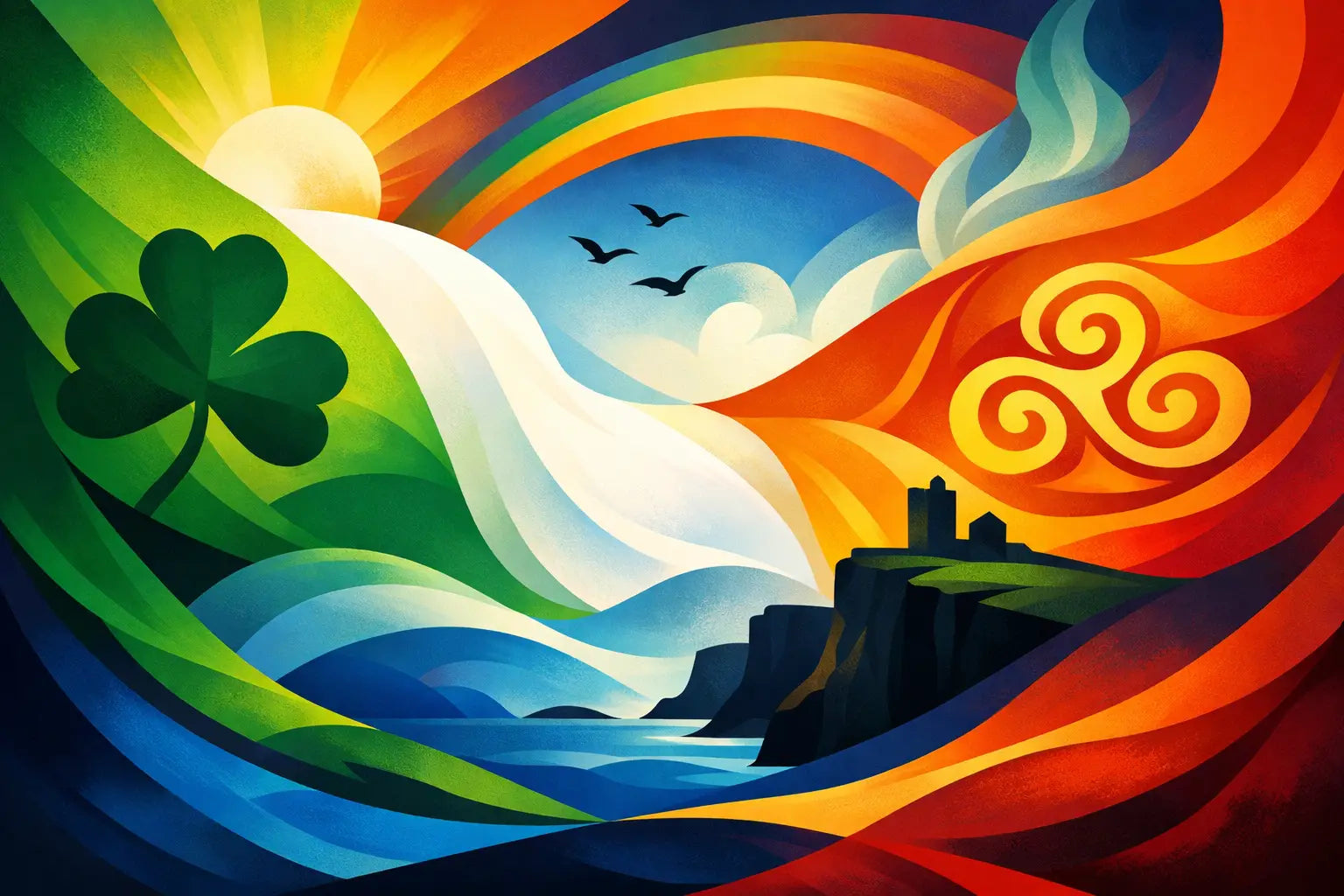
It is tempting to reduce Irishness to symbols everyone recognises. Harps. Shamrocks. Celtic knots. Pubs and postcards. That version travels well, but it only tells part of the story. Modern Irish identity is bigger than heritage packaging. It is history and pressure. It is humour and contradiction. It is pride without needing permission.
At its core, modern Irish identity is built from a few forces that keep colliding and reshaping each other. The first is history - colonisation, resistance, religion, migration, independence, conflict, and reinvention. The second is culture - language, music, sport, storytelling, local loyalties, and a sharp instinct for not taking authority at face value. The third is modern life itself - global media, mixed identities, urban style, politics, class shifts, and the fact that being Irish in 2026 does not look the same as it did in 1986, never mind 1886.
That matters because identity is not a museum object. It changes when people do.
Irishness Is No Longer a Fixed Look
There was a time when Irish identity, especially abroad, was flattened into nostalgia. The old country. The family farm. The sainted granny. The sentimental ballad. That emotional link still matters. But modern Irish identity has moved beyond being framed only through memory.
Now it can look like streetwear with Ogham references. Gold jewellery carrying old symbols in a cleaner, harder form. County pride styled without cliché. It can sound like Irish hip-hop, not just trad. It can carry Gaeilge in a graphic way that feels current, not performative. Culture has not been preserved under glass. It has been restyled.
That restyling is not superficial. It says something deeper - Irishness does not need to dress up as heritage theatre to be valid. It can be sharp, minimal, outspoken, global. It can carry the old meanings without looking old.
The Role of Language in Modern Irish Identity
The Irish language holds a unique place here. Not everyone speaks Gaeilge fluently. Plenty of Irish people do not speak it beyond school-level basics. Plenty in the diaspora know only a few words. Yet the language still matters because it carries a worldview, a history, and a refusal to disappear.
Using Irish today can mean many things. For some, it is daily life. For others, it is an act of cultural return. For others still, it is symbolic - a way of saying this identity did not begin in English and does not end there either.
There is a trade-off worth admitting. Sometimes language gets used as surface decoration. A word printed on a garment can be meaningful, but meaning depends on intent too. The strongest modern use of Irish is not token. It is confident. It treats the language as alive, not ornamental. Even one phrase can carry force when it is used with respect and clarity.
Heritage and Rebellion Sit Side by Side
One of the most honest answers to what is modern Irish identity is this - it is inheritance with an edge.
Irish culture has long carried a rebellious streak. Not rebellion for show, but a deep resistance to being defined by outside approval. That can come from political history, class history, or cultural survival. It can show up in how people speak, dress, vote, organise, create, and remember.
But rebellion on its own is not enough. Modern Irish identity also holds tenderness - family ties, grief, place, ritual, care for the dead, loyalty to the living. The point is not that Irishness is tough. The point is that it contains both softness and steel.
That is why symbols still matter. The Claddagh is not just decorative. The county crest is not just a badge. Even the flat cap, reworked properly, is not costume. These things hold memory. Modern identity does not reject them. It decides how to wear them now.
Diaspora Identity Counts Too
There is often tension around who gets to claim Irishness. Fair enough. The experience of living in Ireland is not the same as having Irish grandparents in London, Liverpool, Boston, Sydney, or Glasgow. The daily context is different. The politics are different. The intimacy with the culture can be different too.
Still, diaspora identity is not fake by definition. It just comes with its own questions.
For some people, Irishness in the diaspora is loud and celebratory because it had to survive distance. For others, it is quieter and more private. Some know the county. Some only know the family name. Some are reconnecting after generations of drift. That process can be awkward, even self-conscious. It can also be deeply real.
The strongest version of diaspora identity is not performance for applause. It is curiosity, respect, and consistency. Learn the history. Listen more than you posture. Let the connection deepen beyond green novelty once a year. Identity grows when it is fed.
Modern Irish Identity Is Also Political
Not party political in every case, but political in the broader sense that identity always sits inside power, memory, and belonging. Questions around partition, migration, language rights, class, religion, queerness, race, and national belonging all shape what Irishness means now.
That means modern Irish identity cannot be reduced to a single background or belief system. Ireland is more diverse than old clichés allow. There are people who are Irish and Black, Irish and Polish, Irish and Muslim, Irish and queer, Irish and newly arrived, Irish and from families that have been here for centuries. None of that weakens Irish identity. It shows it is alive.
Of course, not everyone agrees on where the boundaries sit. That tension is part of the story. Identity gets sharper where it is contested. But if Irishness is going to mean anything in the present, it has to be strong enough to face reality rather than hide in sentiment.
Style Has Become Part of the Conversation
Clothes do not create identity, but they can express it with unusual clarity. What you wear in public says who you are willing to be seen as. That is why Irish identity in fashion matters more now than it used to.
For years, too much Irish design was stuck between tourist tat and formal heritage wear. One was disposable. The other was often too rigid for everyday life. That left a gap for something more honest - pieces that carry Irish symbolism, language, and attitude without looking like costume.
This is where modern identity becomes visible. Not staged. Not sentimental. Just present. A ring with meaning. A jersey with memory. A graphic that speaks in your own register. EIRIN sits in that space by treating Irishness as something to wear with intent, not something to wheel out for effect.
That shift matters because style is one of the clearest ways people build a sense of self. If your heritage only appears as novelty, it stays shallow. If it can live in your everyday wardrobe, it becomes part of how you move through the world.
So, What Is Modern Irish Identity Really?
It is not one accent, one religion, one county, or one political stance. It is not only for those born on the island, and it is not automatically owned by anyone with a distant surname either. It is something more demanding than that.
Modern Irish identity is a living mix of heritage, memory, language, style, struggle, humour, and choice. It is carried by people in Ireland and beyond who feel a real connection to the culture and are willing to engage with it honestly. Sometimes that looks rooted and local. Sometimes it looks hybrid and global. Most of the time, it looks like both.
The best part is that Irish identity does not need to be frozen to stay true. It can evolve without folding. It can adapt without asking to be diluted. It can be old in meaning and current in form.
Wear it loudly or carry it quietly. Learn more of it. Question parts of it. Reclaim the bits that were flattened or sold back as stereotype. Modern Irish identity is not about fitting a script. It is about knowing what is yours, and having the nerve to show it.


