

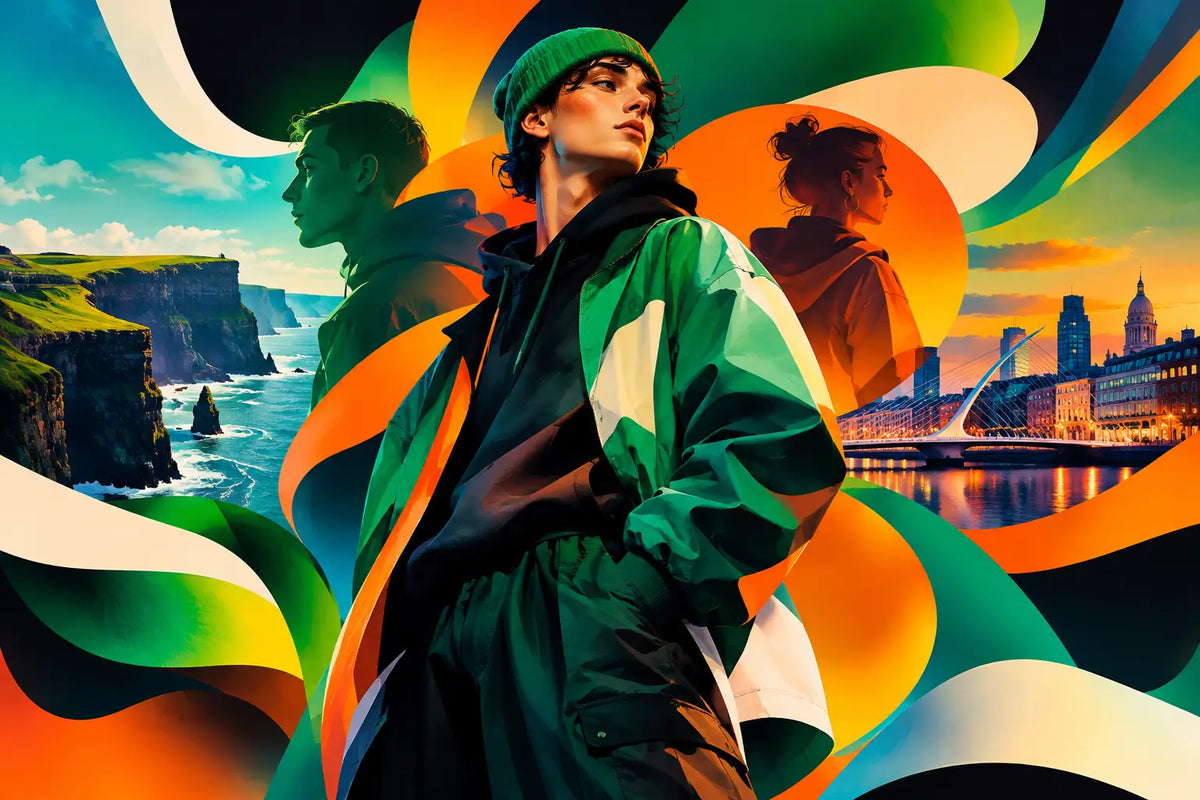
A Gaelic phrase across the chest. A club-style jersey worn nowhere near a pitch. A Claddagh ring paired with cargos and clean trainers. None of it needs explaining to the person wearing it. That is where the future of Irish streetwear begins: not with costume, nostalgia or approval, but with a visible sense of self.
For too long, Irish-inspired clothing has been divided into two lanes. There was the souvenir shop version - leprechauns, novelty slogans, cheap green fabric - and there was formal heritage wear, kept for weddings, parades or occasions. Streetwear is breaking that split. It takes what matters from Irish culture and puts it back into everyday life, with better cuts, sharper graphics and no need to soften the message.
The Future of Irish Streetwear Is Identity, Not Costume
The strongest Irish streetwear does not ask people to perform a version of Irishness for tourists. It gives them room to wear their own. That can mean the Irish language, county pride, music, working-class history, sport, migration, rebellion, faith, family or simply the feeling of being connected to a place.
This matters most for a global diaspora. A second-generation Irish person in Birmingham, Boston or Melbourne may not have the same relationship with Ireland as someone raised in Cork or Belfast. That does not make the connection less real. Clothing can become a daily marker of belonging when geography is not.
The design has to earn that emotional weight. A slogan in Gaeilge is stronger when the spelling is right, the type is considered and the message is treated as living language rather than decoration. A flat cap works when it is reworked for the present, not styled as a museum piece. Heritage is the reference point. It should never be the finishing line.
Symbols Will Carry More Meaning
Irish streetwear has a rich visual vocabulary. The Claddagh, Celtic knots, harp forms, shamrock imagery, county colours, old crests and Gaelic lettering can all work. But familiarity is not enough. Symbols become powerful when designers understand the stories, tensions and communities attached to them.
That means context counts. Ireland contains many identities, and some symbols carry political, religious or regional meaning that cannot be stripped away for a quick graphic. Good design does not pretend those histories do not exist. It makes choices with care and clarity.
The opportunity is bigger than repeating the usual icons. Road signs, pub typography, hand-painted shop fronts, GAA terraces, rural dancehall posters, Irish-language placenames and the texture of old football programmes all offer material that feels local without becoming predictable. The most memorable pieces will find details people recognise before they can name them.
Language will move from slogan to style
Gaeilge is already appearing more visibly in fashion, and that should continue. Its presence says something immediate: this culture is current, not archived. Yet the next step is not plastering random words across a hoodie. It is using language with intention.
A short phrase can be confrontational, affectionate or quietly personal. The right one has rhythm. It sits naturally within the design. It respects speakers rather than treating Irish as an aesthetic shortcut. For brands, that may mean consulting fluent speakers, paying attention to dialect and resisting translations that flatten the meaning.
For wearers, it means there is space to choose how loudly they want to speak. Not every piece needs a giant declaration. Sometimes a small embroidered word, a label detail or a line inside the collar says more.
Less Imitation, More Local Confidence
Streetwear has always travelled. American hip-hop, British terrace culture, skateboarding, football casuals and Japanese workwear have shaped the way people dress across Ireland. That exchange will not stop, nor should it. The problem starts when Irish brands merely copy the silhouette, the language and the release tactics of elsewhere.
The future is not an Irish flag pasted onto an imported trend. It is local confidence expressed through global clothing. Think heavyweight tees with graphics that feel like they belong on a wall in Dublin, Derry, Limerick or Galway. Think headwear that borrows from familiar working shapes but is built for modern wardrobes. Think jerseys that nod to sport while living comfortably with denim, jewellery and trainers.
EIRIN Apparel sits in that space: Irish references made to be worn beyond Ireland, without sanding down their edge. That is the direction worth backing. From Ireland. For everywhere.
The Jersey Will Keep Evolving
The modern jersey is no longer reserved for match day. Its appeal is emotional and visual at once. It carries team memory, local colour, numbers, collars and the energy of the crowd. In streetwear, it becomes a looser canvas for place and allegiance.
Irish-inspired jerseys can go far beyond replicas. A design may use a county palette without copying a county kit, draw on old-school panel construction, or build a fictional crest around a phrase or symbol. The difference is crucial. Referencing sporting culture can feel fresh; copying official identity without thought feels lazy.
There is a trade-off here. Jerseys are often more complex and expensive to produce than a printed tee, particularly when using embroidery, woven badges and considered fabric. Not everyone wants to pay premium money for one. A smart collection needs entry points alongside statement pieces - caps, socks, accessories and jewellery that carry the same world at a lower commitment.
Craft Has to Be Felt, Not Announced
People are more sceptical than they were five years ago. A loud campaign cannot hide thin fabric, poor print quality or a fit that loses shape after two washes. If a brand speaks about heritage, people expect it to show respect in the product itself.
That does not mean every Irish streetwear label must make everything locally. Small-scale production in Ireland can be costly, and global customers still expect fair pricing. It means being honest about where garments are made, choosing quality where it has real impact and refusing disposable design.
A well-cut heavyweight tee, durable embroidery, a properly finished cap and jewellery made to be worn regularly all build trust. Limited runs can help reduce waste and keep ideas focused, but scarcity for its own sake gets old quickly. The piece has to deserve its place in someone’s rotation.
Accessories will become the everyday signal
Not everyone wants their identity printed across their chest. Accessories offer a different kind of visibility. A ring, pendant, scarf, cap or keffiyeh can hold symbolism close while letting the rest of an outfit stay stripped back.
This is especially relevant as Irish streetwear matures. The aim is not to dress head to toe in references. It is to build a recognisable personal uniform. One piece can carry the cultural charge. The rest can stay quiet.
Jewellery has particular staying power because it moves beyond seasonal drops. A Claddagh-inspired piece or a modern harp detail can become part of someone’s daily life, passed between generations or worn through changing styles. The best accessories do not chase every trend. They gather meaning with use.
Community Will Matter More Than Hype
The next era will not be won by whoever shouts loudest online. It will belong to brands that understand who they are speaking to and invite real participation. That could mean photographing customers in their own cities, collaborating with Irish artists, supporting grassroots sport, commissioning musicians or working with language communities.
Authenticity cannot be mood-boarded. It comes from proximity. If a brand claims culture, it should know the people making it, wearing it and challenging it. This is also where diaspora voices matter. Irishness is not confined to one island, and it should not be reduced to a single look.
There is room for boldness without gatekeeping. Someone can wear a Gaelic slogan because it connects them to family. Someone else can wear it because they speak the language every day. Both relationships can sit in the same culture, provided the work is made with respect rather than extraction.
The future of Irish streetwear will not look like a uniform. It will look like people choosing what they carry forward: a word, a crest, a colour, a ring, a story. Wear the pieces that mean something. Leave the rest behind.


