

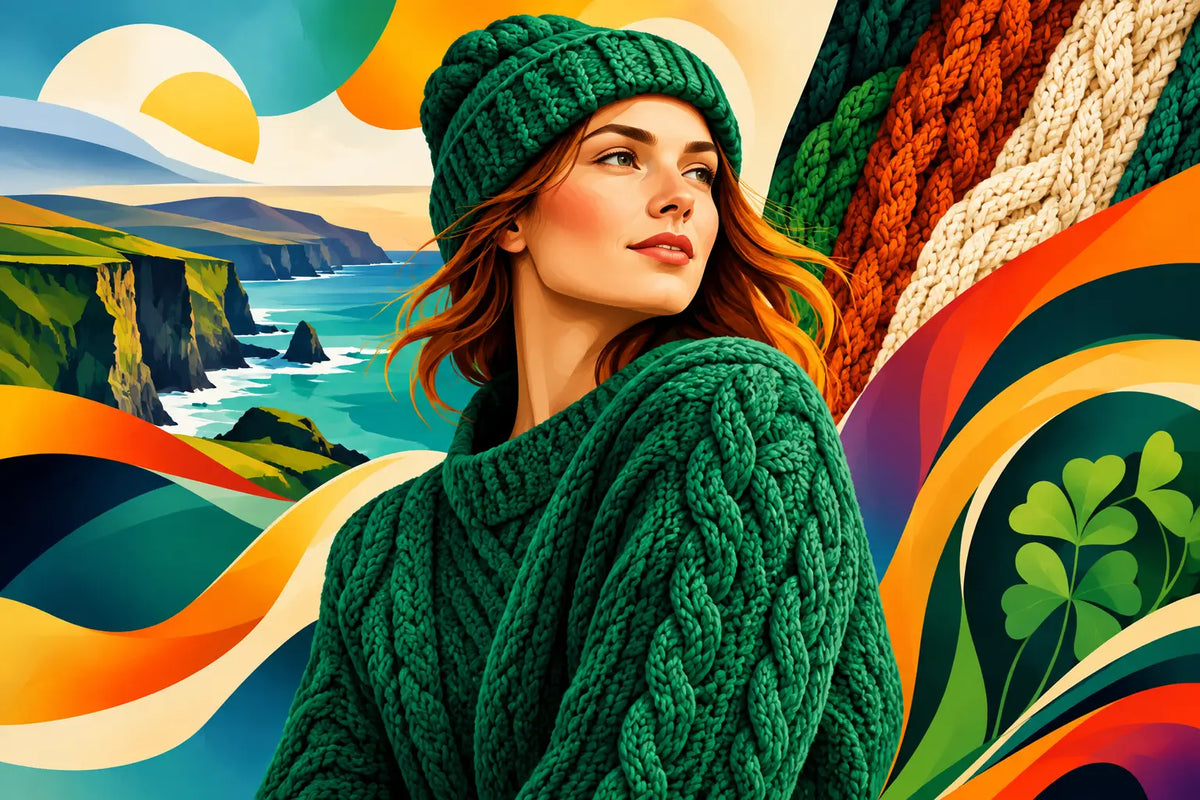
Irish knitwear was never meant to sit quietly at the back of a wardrobe, waiting for bad weather. It was built for Atlantic wind, working hands and communities that knew a garment could say something about where you came from. That spirit still matters. The best pieces do more than keep you warm. They carry texture, memory and a kind of confidence that fast fashion cannot manufacture.
For anyone with Ireland in their blood, their family story or simply their sense of style, knitwear is a way to wear that connection without turning yourself into a postcard. The point is not to look like you are headed to a themed pub. The point is to wear heritage on your own terms.
Irish Knitwear Has Always Had Something to Say
The Aran jumper is the most recognised form of Irish knitwear, and for good reason. Its raised cables, honeycombs, diamonds and basket stitches have a presence that a plain knit does not. These patterns were practical as well as striking. Dense wool trapped warmth, while the heavily textured construction held up to hard use in a coastal climate.
Popular stories attach fixed meanings to every stitch - cables for safety, diamonds for success, honeycomb for hard work. Some of that symbolism has been shaped and strengthened over time. What is beyond doubt is that the garments came from skilled hands and reflected the visual language of island life. They were never flimsy or anonymous.
That is the real power of Irish knitwear. It connects labour, landscape and identity in one piece of clothing. You do not need to explain it to everyone who sees it. The texture does the talking.
Choose the Knit, Not the Stereotype
A good Irish-inspired jumper should feel like a choice, not fancy dress. There is nothing wrong with a classic natural wool Aran, especially when the weather turns sharp. But heritage has more than one uniform. A cropped cardigan, an oversized crew neck, a ribbed beanie or a dark, graphic knit can carry the same cultural weight with a very different attitude.
Start with the role it needs to play in your wardrobe. A heavy, undyed wool jumper gives you maximum warmth and texture, but it may feel too bulky for crowded trains, overheated pubs or daily layering. Merino is softer and lighter against the skin, making it easier to wear under a coat. Wool blends can be more affordable and lower-maintenance, though they may lose some of the depth, durability and natural feel of pure wool.
Colour changes the message too. Cream and oatmeal are traditional for a reason: they show off stitchwork and work with almost anything. Charcoal, black, forest green and deep navy give the same heritage shape a sharper, more urban edge. If the knit is heavily patterned, keep the rest of the outfit clean. Let one strong piece lead.
Fit is where many people get it wrong. A traditional jumper can look great with room through the body, but oversized should still look intentional. You want ease, not fabric swallowing your frame. A closer fit works under an overcoat or field jacket; a relaxed fit earns its place with straight denim, cargos or tailored trousers. There is no rule saying heritage must be worn politely.
Look for substance in the details
The label matters less than the garment in your hands. Check the fibre content, feel the density of the knit and look at the finishing around the cuffs, collar and seams. A well-made piece holds its shape after wear. It does not twist at the side seams or feel thin where it should feel substantial.
Natural wool has character. It can feel slightly rougher than synthetic yarn, especially before it softens with wear. That is not automatically a flaw. Still, if you have sensitive skin, choose fine merino or wear a lightweight long-sleeve layer beneath it. Heritage should feel lived in, not endured.
How to Wear Irish Knitwear Now
Forget the head-to-toe Celtic costume. Modern styling comes from contrast. Pair a textured cream jumper with loose black trousers and worn-in leather boots. Wear a dark cable knit under a structured coat, then add a simple cap rather than another heritage-heavy accessory. Match a ribbed wool beanie with a clean overshirt and relaxed jeans. The old and the new make each other stronger.
Irish knitwear also works beyond winter. A lighter merino crew neck is useful through spring and cool summer evenings, particularly in places where the weather changes its mind every hour. Throw it over a plain tee, not a collared shirt if you want to keep the look more street than country house. Roll the sleeves slightly. Make it yours.
For diaspora wearers, this matters even more. You might be in London, Liverpool, Boston, Glasgow or further afield, but a knit can keep a piece of home in the everyday rotation. It does not need a shamrock stitched across the chest to feel Irish. A familiar texture, a strong silhouette or a quiet nod to the language and landscape can do more.
That is the difference between heritage and novelty. Novelty asks to be noticed. Heritage has nothing to prove.
Caring for Wool Without Ruining It
Wool does not need washing after every wear. It is naturally breathable and resistant to odour, so airing your jumper flat for a few hours is often enough. Washing it too often is one of the fastest ways to dull the fibres and shorten its life.
When it does need a clean, follow the care label first. Hand washing in cool water with a wool-safe detergent is usually the safest route. Do not wring it out. Press out excess water gently, roll it in a towel, then reshape and dry it flat. Hanging a wet jumper can stretch the shoulders and pull the body out of shape.
Skip the tumble dryer unless you are deliberately trying to create a garment for a child. Heat and agitation can felt wool quickly, shrinking it into something dense and unforgiving. Store knitwear folded rather than on hangers, and keep it clean before putting it away for the season. Moths are less interested in wool itself than in the skin oils and food traces left on worn clothing.
Pilling is normal, especially where a jumper rubs against a jacket, bag strap or seat belt. A fabric comb or wool shaver will tidy it up. Treat it as maintenance, not a sign that the piece has failed. Good clothes ask for a little respect because they are built to stay.
Irish Knitwear Is Not Stuck in the Past
There is a temptation to freeze Irish style in sepia tones: fisherman jumpers, village postcards and symbols stripped of their edge. That version of heritage is easy to sell, but it is not the whole story. Ireland has always made culture from friction - tradition and rebellion, memory and movement, local roots and global reach.
Modern Irish knitwear belongs in that tension. It can honour the workmanship of Aran without copying every old formula. It can be soft, oversized, minimal, loud, black, cropped or built for the street. It can sit beside a retro jersey, a reworked flat cap or a piece of symbolic jewellery and still feel coherent.
That is the lane EIRIN stands in: identity over approval. Wear the cable knit with trainers. Put the wool cap on with a tailored coat. Take the familiar shapes somewhere new. Culture is not preserved by locking it away. It lasts because people keep wearing it, changing it and giving it a place in their own lives.
Choose a piece with weight, wear it often, and let it collect its own stories. That is how knitwear stops being a souvenir and becomes yours.


![Eirin Apparel Claddagh Earrings Chunky Gold-Plated Claddagh Hoop Earrings – 'Soláis' (Sunlight) [collection-cover-only]](http://eirin.co/cdn/shop/files/eirin-apparel-claddagh-earrings-chunky-gold-plated-claddagh-hoop-earrings-solais-sunlight-1260024173.png?v=1790378984&width=1254)

![Eirin Apparel Claddagh Earrings Chunky Silver-Plated Claddagh Hoop Earrings – 'Réalta' (Starlight) [collection-cover-only]](http://eirin.co/cdn/shop/files/eirin-apparel-claddagh-earrings-chunky-silver-plated-claddagh-hoop-earrings-realta-starlight-1260024174.png?v=1790378955&width=1254)

![Eirin Apparel Claddagh Earrings Dainty Gold-Plated Claddagh Hoop Earrings – 'Gríanóg' (Little Sun) [collection-cover-only]](http://eirin.co/cdn/shop/files/eirin-apparel-claddagh-earrings-dainty-gold-plated-claddagh-hoop-earrings-grianog-little-sun-1260024172.png?v=1790379015&width=2048)

![Eirin Apparel Claddagh Earrings Gold-Plated Sterling Silver Claddagh Earrings – ‘Croi Óir’ (Golden Heart) [collection-cover-only]](http://eirin.co/cdn/shop/files/eirin-apparel-claddagh-earrings-gold-plated-sterling-silver-claddagh-earrings-croi-oir-golden-heart-1260024175.png?v=1790378802&width=2048)

![Eirin Apparel Claddagh Earrings Celtic Knot Claddagh Earrings – ‘Fáinne an Ghrá’ (Ring of Love) [collection-cover-only]](http://eirin.co/cdn/shop/files/eirin-apparel-claddagh-earrings-celtic-knot-claddagh-earrings-fainne-an-ghra-ring-of-love-1260024176.png?v=1790378776&width=2048)

![Eirin Apparel Women's Earrings Women's Irish Harp Earrings – 'Fuaim' (Sound) [collection-cover-only]](http://eirin.co/cdn/shop/files/eirin-apparel-women-s-earrings-women-s-irish-harp-earrings-fuaim-sound-1260024177.png?v=1790378295&width=2048)

![Eirin Apparel Claddagh Ring Women's Gold-Plated Classic Claddagh Ring – ‘Gréine’ (Of the Sun) [collection-cover-only]](http://eirin.co/cdn/shop/files/eirin-apparel-claddagh-ring-women-s-gold-plated-classic-claddagh-ring-greine-of-the-sun-1260024155.png?v=1790378897&width=1254)

![Eirin Apparel Claddagh Ring Women's Silver-Plated Classic Claddagh Ring – ‘Gealaí’ (Moonlight) [collection-cover-only]](http://eirin.co/cdn/shop/files/eirin-apparel-claddagh-ring-women-s-silver-plated-classic-claddagh-ring-gealai-moonlight-1260024154.png?v=1790378925&width=2048)

![Eirin Apparel Claddagh Ring Women’s Two-Tone Claddagh Ring – ‘Síorghrá’ (Eternal Love) [collection-cover-only]](http://eirin.co/cdn/shop/files/eirin-apparel-claddagh-ring-women-s-two-tone-claddagh-ring-siorghra-eternal-love-1260024158.png?v=1790378653&width=1254)

![Eirin Apparel Claddagh Ring Women’s Chunky Claddagh Ring – 'Dílse' (Faithful) [collection-cover-only]](http://eirin.co/cdn/shop/files/eirin-apparel-claddagh-ring-women-s-chunky-claddagh-ring-dilse-faithful-1260024159.png?v=1790378561&width=1254)

![Eirin Apparel Women's Ring Women's Celtic Knot Ring – 'Síorfhite' (Everwoven) [collection-cover-only]](http://eirin.co/cdn/shop/files/eirin-apparel-women-s-ring-women-s-celtic-knot-ring-siorfhite-everwoven-1260024160.png?v=1790378476&width=1254)

![Eirin Apparel Women's Ring Women's Celtic Crown Ring – 'Banríon' (Queen) [collection-cover-only]](http://eirin.co/cdn/shop/files/eirin-apparel-women-s-ring-women-s-celtic-crown-ring-banrion-queen-1260024161.png?v=1790378441&width=1254)


