

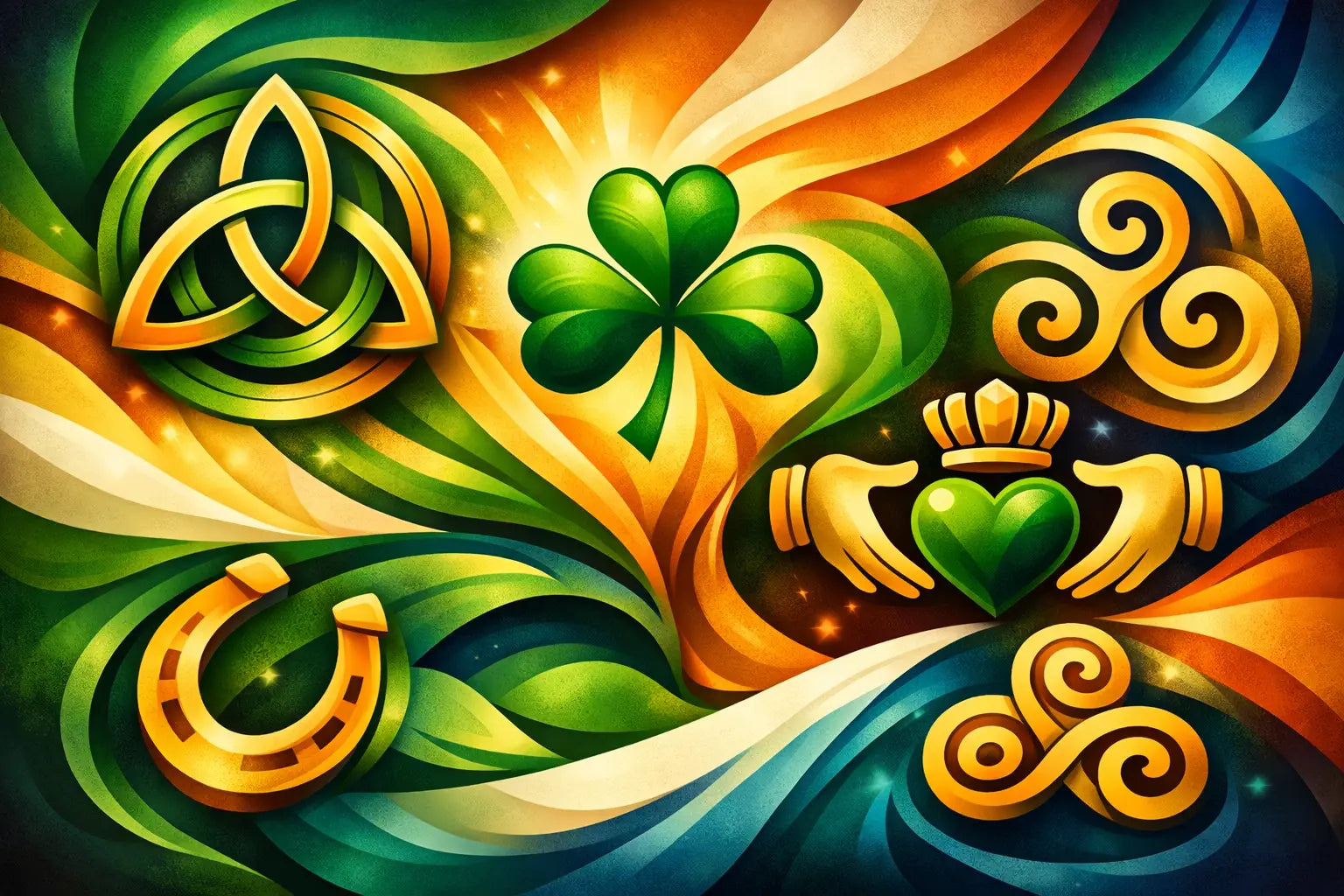
A pendant sits close to the chest. That is why the top symbols for Irish pendants are more than decoration. They carry love, memory, place and conviction in a form you can wear every day. Choose one because it means something to you, not because it looks like the expected version of Irishness.
For some, that meaning is family back home. For others, it is a connection rebuilt across generations and oceans. And sometimes it is simpler: a refusal to make yourself smaller, quieter or less Irish for anyone’s comfort.
Top Symbols for Irish Pendants and What They Say
The right symbol depends on the story you want to carry. Some are intimate. Some are spiritual. Some are unmistakably national. The strongest choice is usually the one that still feels like yours after the trend has moved on.
The Claddagh: love with backbone
The Claddagh is one of the most recognisable Irish jewellery symbols, and for good reason. Its heart stands for love, the hands for friendship and the crown for loyalty. Together, they make a promise that has more substance than a passing gesture.
A Claddagh pendant works beautifully as a gift for a partner, friend, sibling or parent. It also works when you buy it for yourself. Love does not have to mean romance, and loyalty does not have to be owed to anyone else. Worn as a pendant rather than a ring, it becomes less about old rules and more about keeping your people close.
Look for a clean interpretation if your style is modern. A sharply defined heart and crown can feel as strong with a plain white T-shirt as it does with a shirt or dress on a night out.
The triskele: movement, balance, becoming
Three spirals turning from one centre, the triskele is older than most people realise. Variations of the motif appear in ancient Irish stone art, including at Brú na Bóinne. Its exact meaning is not fixed, which is part of its power.
People often read the three arms as past, present and future, or mind, body and spirit. Others see momentum: a life that keeps moving, even when the route is not straight. If you want a symbol of heritage without choosing something overtly romantic or religious, the triskele has depth without needing an explanation on a placard.
It suits minimal pendants especially well. The spiral has energy on its own, so it does not need heavy ornament to make an impact.
The Celtic knot: connection without an end
Celtic knotwork is built from lines that loop, cross and continue. It has no obvious beginning and no final point. That makes it a natural choice for family ties, enduring friendship and roots that survive distance.
There is a trade-off here. “Celtic knot” covers a wide family of designs, and not every interlaced pattern has one ancient, precise meaning. Be wary of anyone claiming that every loop comes with a rigid historical translation. Choose the pattern for what it represents to you: continuity, connection and the fact that identity is rarely a straight line.
A knot pendant is often the most versatile option in the group. It can be understated enough for daily wear, while still telling those who recognise it exactly where your heart is.
The Irish harp: pride, culture, defiance
The harp is Ireland’s national emblem, but its meaning stretches far beyond official use. It is tied to music, poetry, storytelling and a cultural tradition that endured pressure to disappear. That gives it a quiet force.
A harp pendant is for the person who wants Irish identity to be visible without turning it into costume. It speaks to artistry, heritage and cultural pride in one clear shape. Fine strings and a graceful frame can look elegant, while a bolder, simplified silhouette brings more of a streetwear edge.
Because the harp is such a powerful national symbol, it rewards a confident design. Keep the styling clean and let the form do the talking.
The shamrock: small symbol, big signal
The shamrock may be the most familiar Irish emblem, but familiar does not mean empty. Its three leaves are traditionally associated with St Patrick and the Christian Trinity. Beyond religion, it has become a widely understood sign of Irish connection, welcome and pride.
A shamrock pendant can be playful, personal or quietly sentimental. It is ideal for someone buying their first piece of Irish jewellery, or for a gift that needs no long explanation. The key is avoiding the novelty-shop version. A pared-back shamrock in silver or gold tone feels considered rather than themed.
Remember that the shamrock is not the same as a four-leaf clover. The four-leaf clover is associated with luck; the shamrock carries a distinctly Irish cultural and religious history.
Brigid’s cross: protection and resilience
Made from rushes, Brigid’s cross is traditionally associated with St Brigid and placed in Irish homes as a symbol of protection. Its woven square centre and four arms make a striking pendant shape, particularly for anyone drawn to symbols with a direct link to home, hearth and care.
Brigid herself holds different meanings for different people. She is revered as a Christian saint, while her name and associations also connect to older Irish traditions around spring, fire, healing and poetry. That layered history makes the cross especially resonant for people who prefer symbols that refuse to be reduced to one neat category.
This is a pendant with warmth to it. Wear it as a reminder that softness and strength are not opposites.
The Celtic cross: faith, history and place
The Celtic cross combines a cross with a circular ring, creating one of Ireland’s most enduring visual forms. For many wearers, it is a straightforward expression of Christian faith. For others, it recalls graveyards, monasteries, family history and the landscape of Ireland itself.
Context matters with this one. If faith is central to the wearer, the meaning is clear. If it is not, consider whether the design reflects a genuine connection rather than a borrowed aesthetic. A simple, well-proportioned cross can feel timeless; an overly embellished version can lose the strength of the symbol.
Ogham: make it unmistakably yours
Ogham offers a more personal route. The early Irish alphabet is formed with groups of lines arranged along a central stroke, and it can be used to represent a name, a place or a meaningful word. It is less immediately recognisable than a Claddagh or shamrock, which is exactly the appeal.
An Ogham pendant is for those who want their Irish connection to be felt before it is explained. A name in Irish, a family surname, a county or a private word can turn jewellery into something closer to a keepsake. Accuracy matters, though. Ogham inscriptions need correct spelling and letter conversion, especially where modern names do not map neatly to the historic alphabet.
Choosing a Pendant That Feels Like You
Start with meaning, then think about how you actually dress. A detailed Claddagh or Celtic knot can hold its own as a standalone piece. A small triskele or Ogham bar is better for layering with chains of different lengths. If you live in black, denim, jerseys and oversized basics, choose a bolder silhouette with clean lines. If your look is quieter, a small symbolic pendant can do the work without shouting.
Metal changes the mood too. Silver-coloured finishes keep things crisp and everyday. Gold-toned pieces bring warmth and make a traditional symbol feel more formal. A darker or oxidised finish can bring out texture in knotwork and crosses, but it depends on whether you want heritage detail or a cleaner contemporary look.
There is no universal “most Irish” pendant. The person wearing it decides that. A harp might speak louder to a musician than a shamrock ever could. A Brigid’s cross may mean home to one person and healing to another. Someone else may choose their name in Ogham because their connection is private, hard-won and nobody else’s business.
Wear the symbol that carries your version of Ireland. Not the approved version. Not the souvenir version. Yours.


