

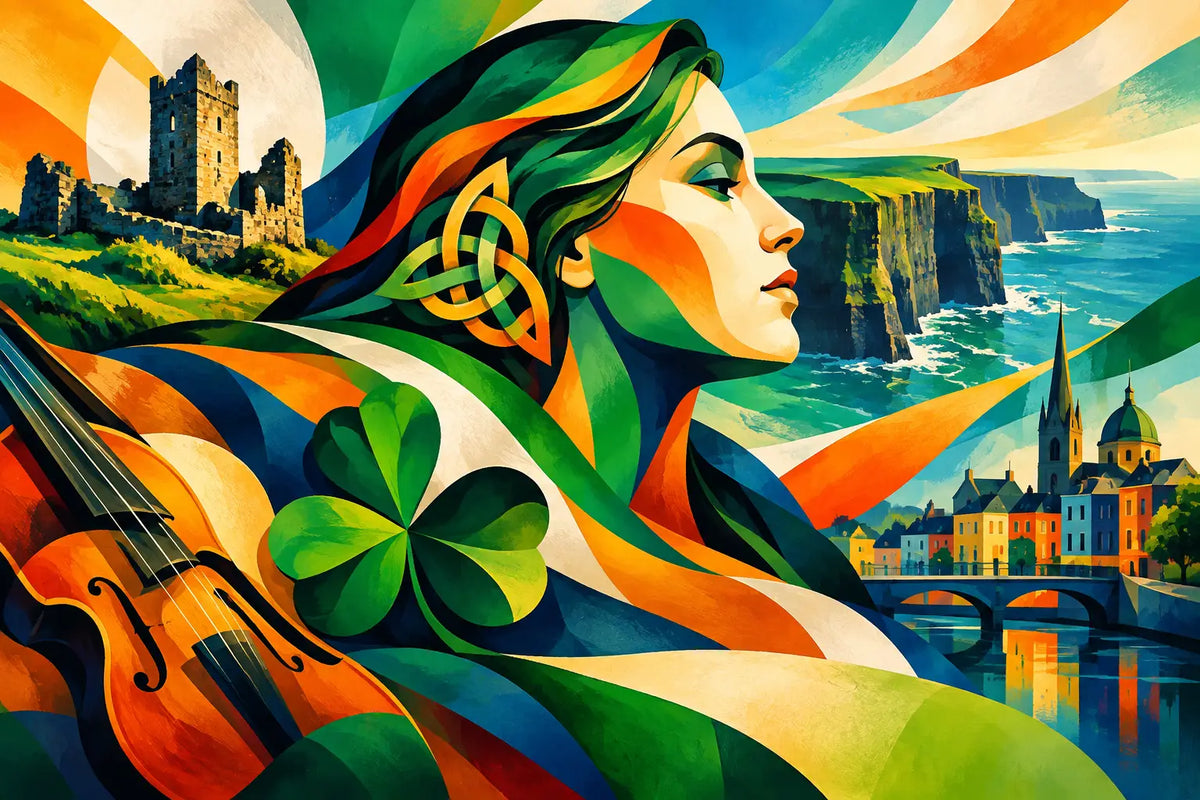
A green novelty tee is not Irish identity. It is a shortcut. Real Irish identity examples carry more weight: the language spoken at home, a county jersey pulled on before a match, a Claddagh passed between generations, a family name pronounced properly, a song everybody knows by the second line.
Irishness is not one look, one politics, one religion or one version of history. It can be loud, quiet, inherited, learned, local, diasporic, traditional or completely reworked. That is the point. Identity is lived. What you wear can be part of the signal, but it should never be the whole story.
Irish identity is not a costume
The easiest mistake is treating Irish culture as a box of familiar props: shamrocks, leprechauns, pints and an annual excuse to wear green. Those things may have a place in celebration, but they cannot hold the full shape of a country with a long, contested and creative history.
A stronger sense of identity leaves room for contradiction. Someone from Cork may feel fiercely local as well as Irish. Someone in Belfast may hold British, Irish, Northern Irish or more than one identity at once. Someone whose grandparents left Mayo for London, Liverpool, Boston or Sydney may feel Ireland most sharply through family stories, music, food and names. None of these experiences is less real because it does not fit a postcard.
That is why the best Irish identity examples are specific. They come from real attachment, not a generic Celtic pattern pasted onto a souvenir.
Language is a living marker
Irish - Gaeilge - holds meaning even for people who do not speak it fluently. A phrase on a wall, a place name, a blessing from a grandparent or the confidence to use cúpla focal can be a thread back to something older than the English-language default.
Words such as grá (love), misneach (courage), saol (life) and sláinte (health) are often used because they carry emotional force. But language deserves more than decorative treatment. Check spelling. Know what a phrase means. Respect regional pronunciation and the fact that Irish is a living language spoken by people across the island.
The same goes for names. Correcting the pronunciation of Ní Bhraonáin, Ó Súilleabháin or Caoimhe may seem small. It is not. Names have been anglicised, misspelt and flattened for generations. Saying them properly is a quiet refusal to let that happen again.
Place names tell their own story
Irish place names are packed with landscape, memory and language. Dún Laoghaire, Cill Chainnigh, Baile Átha Cliath and An Daingean are not awkward alternatives to English labels. They are evidence of how people understood a place before maps made everything easier for outsiders to pronounce.
Using Irish names where appropriate is not a performance. It is a way of recognising that language belongs in public life.
Symbols need context, not permission slips
Irish symbols can be powerful because they say a lot with very little. The Claddagh, for example, holds love, loyalty and friendship in one design: heart, hands and crown. Worn as jewellery, it can mark a relationship, a family connection or simply an affection for the place it comes from.
The harp is another enduring symbol. It appears in art, public life and music, carrying associations with sovereignty and cultural survival. Celtic knots, meanwhile, are widely recognised but often stripped of their origins through mass-produced tourist design. Their visual appeal is real. Their meaning becomes stronger when the design is deliberate rather than decorative filler.
Then there are symbols that require more care. The tricolour has a clear history and remains meaningful to many, while also sitting within present-day political tensions. The same is true of historic emblems, slogans and flags used during periods of conflict. Wearing a symbol is your choice. Knowing its context is your responsibility.
Pride does not need ignorance to look convincing.
Sport, music and ritual create belonging
You do not need to play for a county to understand what GAA can mean. A club jersey, a muddy pitch, a packed pub on match day, a parent shouting from the sideline - these are shared scenes of belonging. County colours can become a lifelong badge, especially for people living away from home.
Rugby, football, boxing, rowing and athletics also shape how Ireland sees itself. Sport creates rituals: the route to the ground, the songs, the old rivalries, the post-match analysis that lasts longer than the match itself. It is culture in motion.
Music works similarly. Trad sessions, rebel songs, punk, folk, hip-hop, dance music and the particular dry humour between tracks all belong in the wider picture. Irish culture is not frozen in a pub session. It changes whenever artists take what they inherited and make it hit differently.
Irish identity examples you can wear
Clothing becomes meaningful when it carries a story you would stand behind without the label attached. That might be a retro jersey with the weight of county pride, a clean Gaelic slogan tee, a flat cap reshaped for city streets, or a Claddagh ring worn every day rather than saved for an occasion.
The strongest looks do not scream for attention with every stereotype available. They choose one clear signal and let it land. Pair an Irish-language tee with simple trousers and trainers. Wear symbolic jewellery with an otherwise understated outfit. Let a heritage cap work with a modern jacket rather than treating it as fancy dress.
There is a trade-off here. A full heritage look can be brilliant at a match, festival or family gathering, but may feel forced if every item is trying to explain your background at once. Everyday style has more impact when it feels natural. One piece with meaning can say more than ten pieces of costume.
This is where modern Irish fashion earns its place. It does not need to imitate the past to honour it. It can use sharp typography, reworked sports references, restrained colour and symbols with purpose. EIRIN approaches Irishness as something worn forward: rooted, defiant and fit for wherever you are.
The diaspora connection is real, but it is personal
For the diaspora, Irish identity can arrive in fragments. A grandad's stories. A grandmother's recipe. A surname on a passport application. A trip that turns familiar family talk into actual streets, hills and voices. There is no quota of knowledge someone must pass before they are allowed to care.
At the same time, heritage is not ownership of every Irish experience. If you are reconnecting from abroad, curiosity goes a long way. Learn the history behind the symbol. Listen more than you claim. Support living culture, not just nostalgia. Connection deepens when it becomes a relationship rather than a costume for one day in March.
For people in Ireland, the reverse can also be true: do not dismiss a diasporic connection because it looks different from your own. Distance changes culture. It does not automatically erase it.
Wear the part that is yours
Start with the detail that genuinely means something to you. It could be your county, your language, your family name, a symbol your mother wore, a lyric, a club or a memory of home. Let that guide the choices you make.
Irish identity has survived because people kept carrying it - in speech, songs, rituals, arguments, design and everyday acts of pride. Wear it with knowledge. Wear it your own way. Let it mean more than green.


![Eirin Apparel Claddagh Earrings Chunky Gold-Plated Claddagh Hoop Earrings – 'Soláis' (Sunlight) [collection-cover-only]](http://eirin.co/cdn/shop/files/eirin-apparel-claddagh-earrings-chunky-gold-plated-claddagh-hoop-earrings-solais-sunlight-1260024173.png?v=1790378984&width=1254)

![Eirin Apparel Claddagh Earrings Chunky Silver-Plated Claddagh Hoop Earrings – 'Réalta' (Starlight) [collection-cover-only]](http://eirin.co/cdn/shop/files/eirin-apparel-claddagh-earrings-chunky-silver-plated-claddagh-hoop-earrings-realta-starlight-1260024174.png?v=1790378955&width=1254)

![Eirin Apparel Claddagh Earrings Dainty Gold-Plated Claddagh Hoop Earrings – 'Gríanóg' (Little Sun) [collection-cover-only]](http://eirin.co/cdn/shop/files/eirin-apparel-claddagh-earrings-dainty-gold-plated-claddagh-hoop-earrings-grianog-little-sun-1260024172.png?v=1790379015&width=2048)

![Eirin Apparel Claddagh Earrings Gold-Plated Sterling Silver Claddagh Earrings – ‘Croi Óir’ (Golden Heart) [collection-cover-only]](http://eirin.co/cdn/shop/files/eirin-apparel-claddagh-earrings-gold-plated-sterling-silver-claddagh-earrings-croi-oir-golden-heart-1260024175.png?v=1790378802&width=2048)

![Eirin Apparel Claddagh Earrings Celtic Knot Claddagh Earrings – ‘Fáinne an Ghrá’ (Ring of Love) [collection-cover-only]](http://eirin.co/cdn/shop/files/eirin-apparel-claddagh-earrings-celtic-knot-claddagh-earrings-fainne-an-ghra-ring-of-love-1260024176.png?v=1790378776&width=2048)

![Eirin Apparel Women's Earrings Women's Irish Harp Earrings – 'Fuaim' (Sound) [collection-cover-only]](http://eirin.co/cdn/shop/files/eirin-apparel-women-s-earrings-women-s-irish-harp-earrings-fuaim-sound-1260024177.png?v=1790378295&width=2048)


![Eirin Apparel Claddagh Ring Women's Gold-Plated Classic Claddagh Ring – ‘Gréine’ (Of the Sun) [collection-cover-only]](http://eirin.co/cdn/shop/files/eirin-apparel-claddagh-ring-women-s-gold-plated-classic-claddagh-ring-greine-of-the-sun-1260024155.png?v=1790378897&width=1254)

![Eirin Apparel Claddagh Ring Women's Silver-Plated Classic Claddagh Ring – ‘Gealaí’ (Moonlight) [collection-cover-only]](http://eirin.co/cdn/shop/files/eirin-apparel-claddagh-ring-women-s-silver-plated-classic-claddagh-ring-gealai-moonlight-1260024154.png?v=1790378925&width=2048)

![Eirin Apparel Claddagh Ring Women’s Two-Tone Claddagh Ring – ‘Síorghrá’ (Eternal Love) [collection-cover-only]](http://eirin.co/cdn/shop/files/eirin-apparel-claddagh-ring-women-s-two-tone-claddagh-ring-siorghra-eternal-love-1260024158.png?v=1790378653&width=1254)

![Eirin Apparel Claddagh Ring Women’s Chunky Claddagh Ring – 'Dílse' (Faithful) [collection-cover-only]](http://eirin.co/cdn/shop/files/eirin-apparel-claddagh-ring-women-s-chunky-claddagh-ring-dilse-faithful-1260024159.png?v=1790378561&width=1254)

![Eirin Apparel Women's Ring Women's Celtic Knot Ring – 'Síorfhite' (Everwoven) [collection-cover-only]](http://eirin.co/cdn/shop/files/eirin-apparel-women-s-ring-women-s-celtic-knot-ring-siorfhite-everwoven-1260024160.png?v=1790378476&width=1254)


